Jam match 3D Review: Grass Walls Instead of Stacked Tiles
Sleepy jelly blocks behind grass walls and a seven-slot tray: a Jam match 3D review of a tile-matching game that rewrites the map rules.
Game at a glance
Jam match 3D
6/ 10
Our score
A hit's core, taken apart and rebuilt. The more you think about it, the scarier it gets.
In this article6 sections
Tap a one-eyed jelly block and it slides out of a grassy field into a tray at the bottom of the screen, where it waits for two more of its color. Three together vanish in a puff. That loop makes Jam match 3D a triple-tile matching puzzle for mobile. It is one of the tile match games built on the pattern of Sheep a Sheep, the hit where tiles lie in overlapping layers and only uncovered ones can be picked.
Jam match 3D keeps the tray and the threes but drops the layers. Every block sits flat on one lawn. A closed eye marks a block that can’t be tapped yet, and raised strips of grass decide which neighbors can wake it. Terrain doing the work that stacking used to do is the whole redesign, and a sharp one.
One-eyed blocks and a seven-slot tray
We played Levels 1 through 7, stopping with one block still on the field near the end of Level 7. Every level asks for the same thing, an empty field, and no goal counter appears on screen. The blocks are glossy square jelly creatures with one large eye and a small toothy mouth, set on a low-poly lawn dotted with blocky trees and flowers.
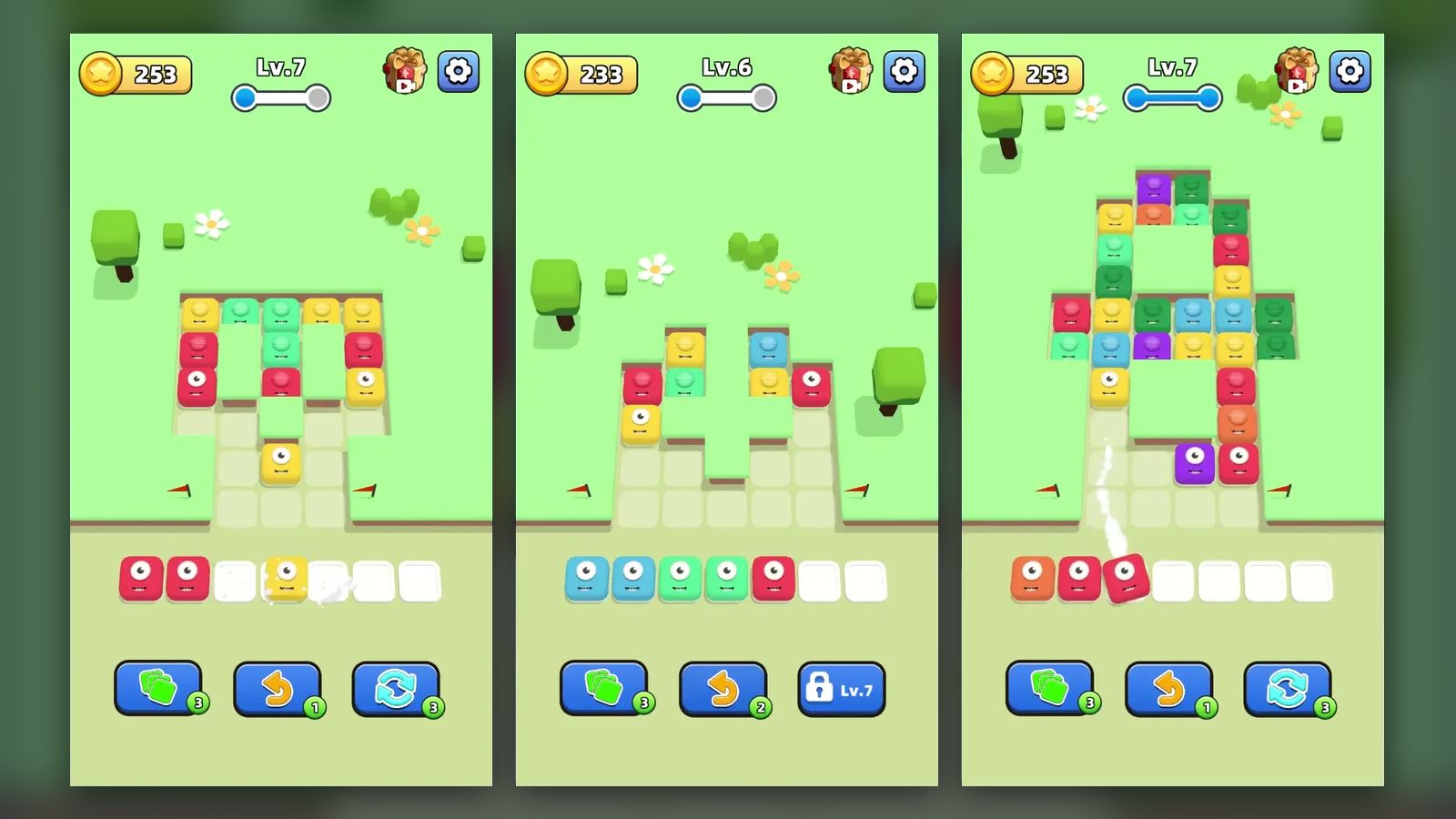
A tapped block slides down the open tiles to the bottom row of the field, leaving a white puff trail, and tumbles into a tray of seven slots below. Matching colors end up side by side there. When three of one color meet, they vanish in a puff and a coin pops up over the tray, so the field empties from its open edges inward.
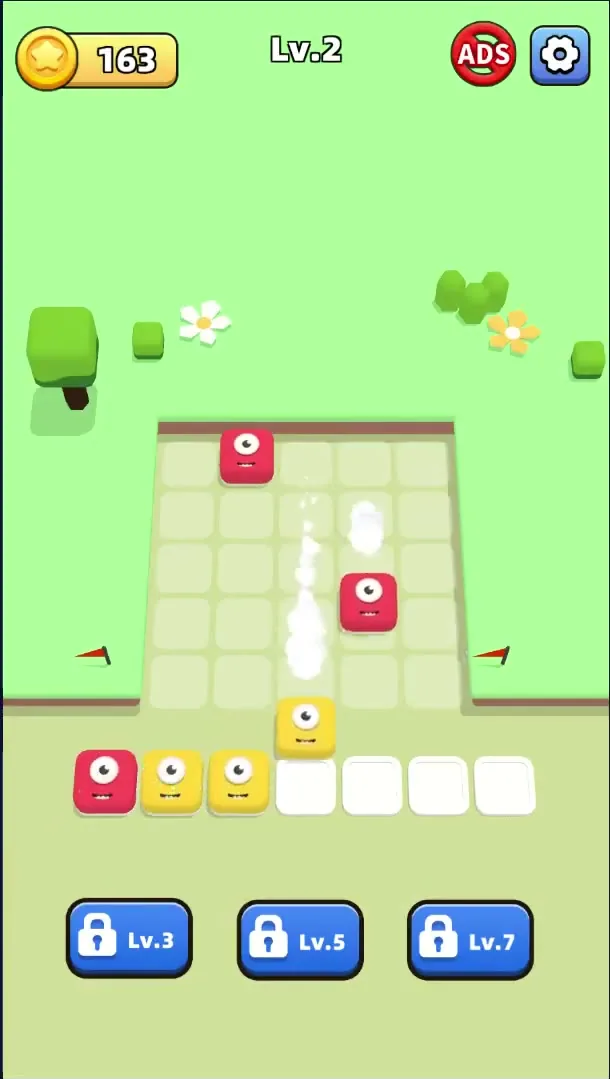
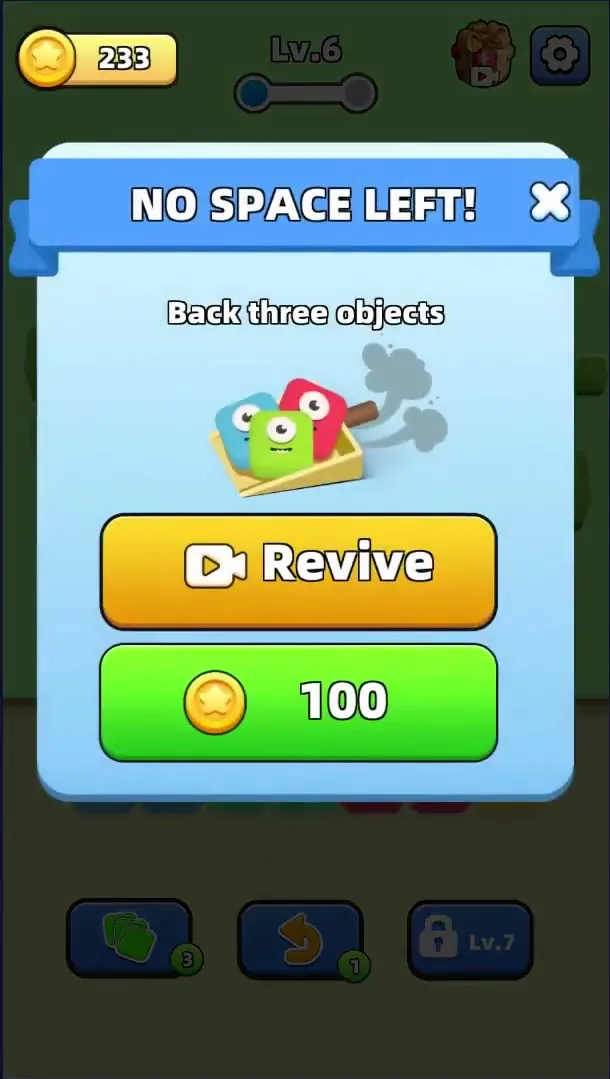
No timer or move counter appears, which leaves the tray as the one limit. Once all seven slots are full, play stops behind a panel headed “NO SPACE LEFT!”, which happened once, on the first field of Level 6. Clearing the last set instead sets off confetti over the empty field, and a reward screen follows.
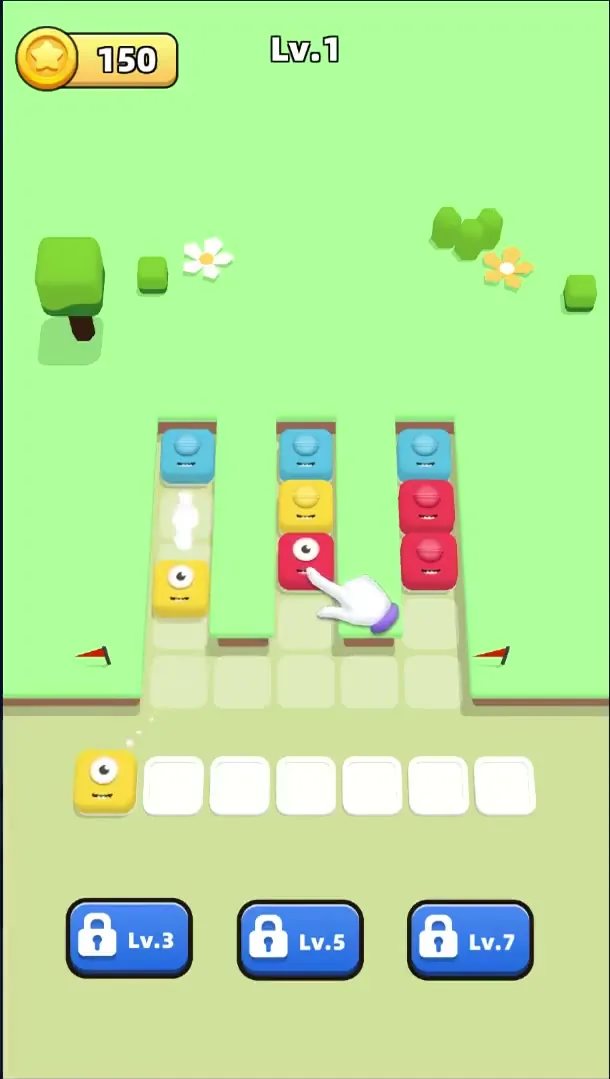
Jam match 3D gameplay runs on single taps. In Level 1, the tutorial, a white hand taps an open-eyed red block in one of three narrow lanes divided by grass strips, and the game’s own tips call this clicking a block. Boosters sit under the tray as a row of three buttons. Nothing in these levels calls for a drag or a swipe.
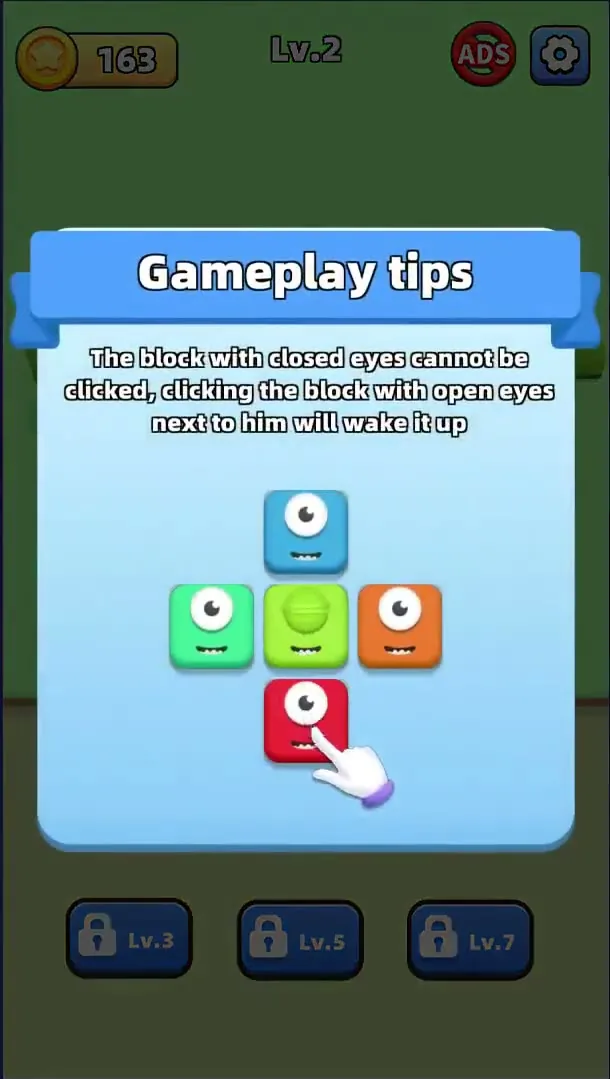
Not every block answers a tap. Some wear a closed, domed lid where the eye should be. A “Gameplay tips” panel in Level 2 gives the rule in the game’s own words: “The block with closed eyes cannot be clicked, clicking the block with open eyes next to him will wake it up.”
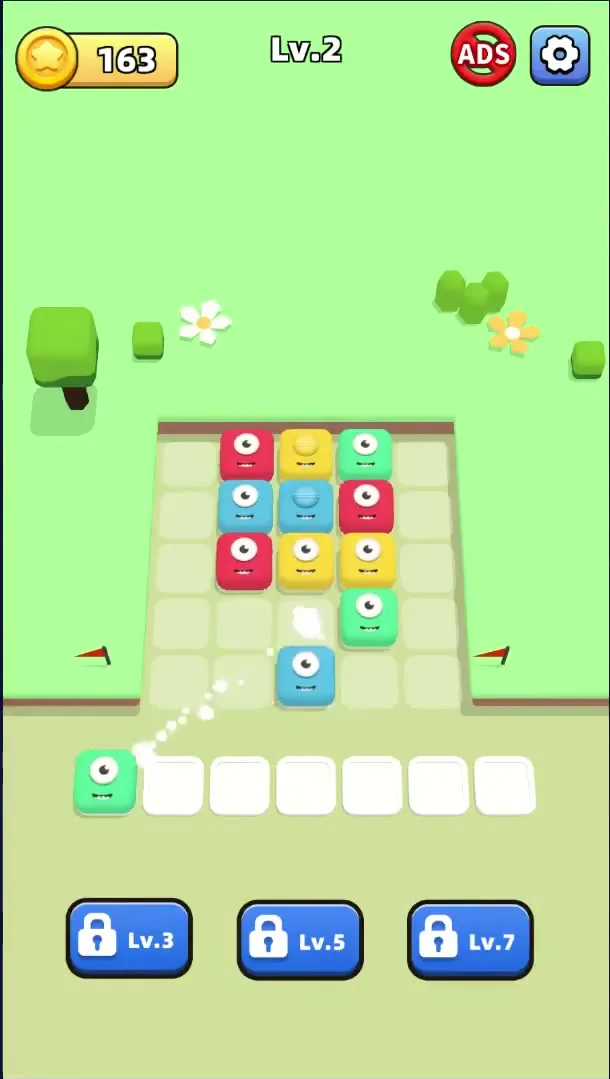
On the field, lids lift as neighbors leave. Early in Level 2, every block in a square cluster is awake except the top two of its middle column, a yellow and a blue. In Level 5 the top-left yellow opens its eyes once the column below it has been cleared.
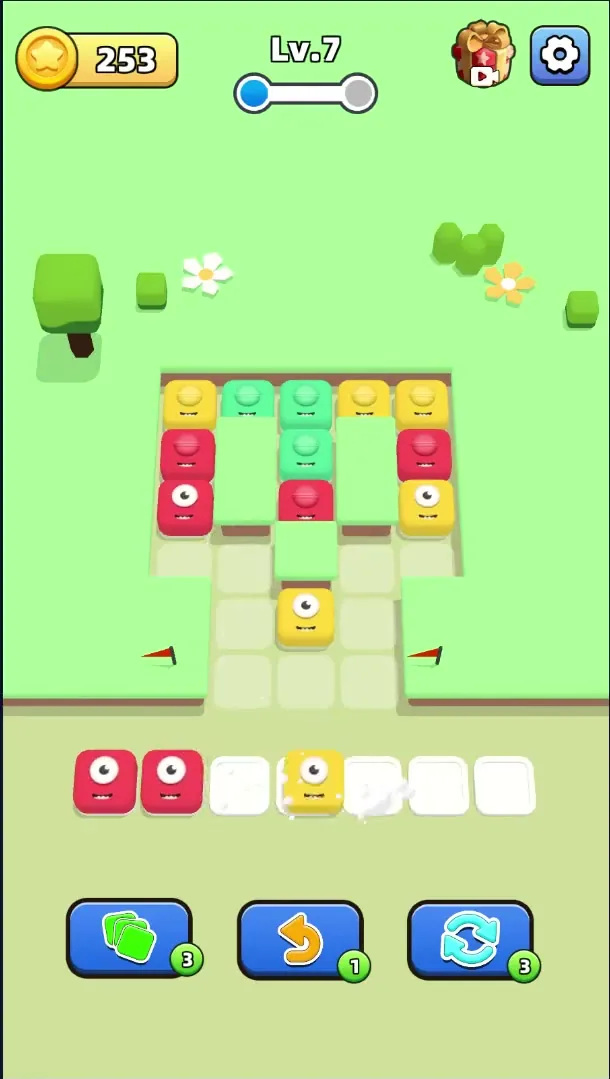
Grass is the other half of the map. Raised squares and strips of turf take up tiles inside the field, and no block ever sits on one. Their shapes keep changing, from lane dividers and a plus to strips, bars, single squares and corners that pinch the field’s edges. Grass can also seal a block in. On the first field of Level 7, the red in the middle column has turf on three sides and keeps its lid down, while the red and the yellow in the outer columns open theirs once the blues beneath them are taken.
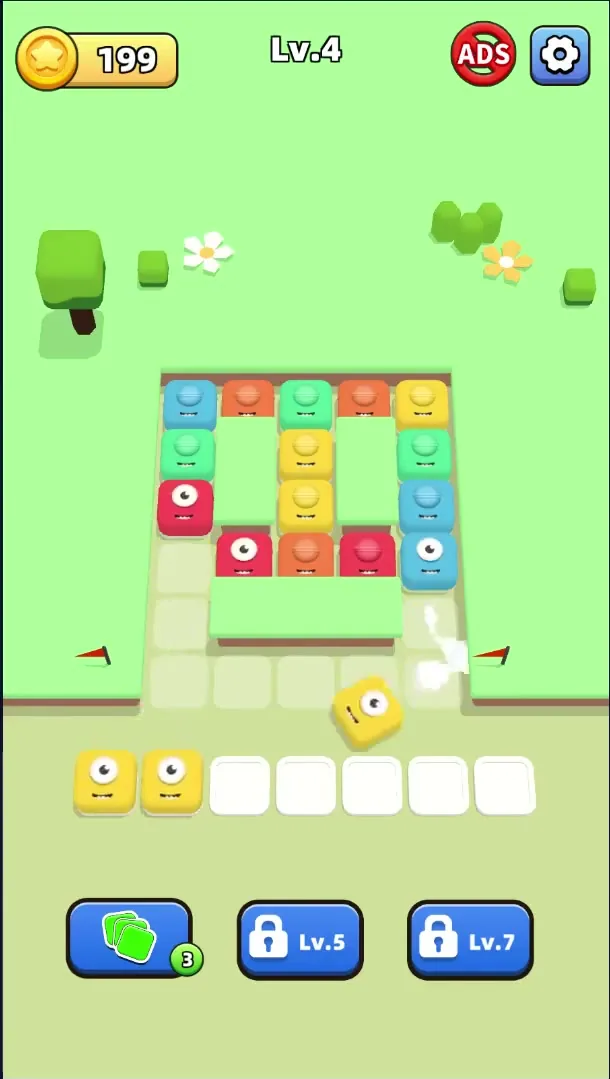
Two short grass strips hang from the top row of Level 4, and a wide grass bar crosses the lower field. Blocks in five colors ring them: a full top row, a column down each side, two yellows between the strips and a row resting on the bar. Early on only three have open eyes, two reds and a blue, while two yellows already sit in the tray and a third flies in to complete the set. Once the orange block under the lower yellow is taken, that yellow wakes, and soon after the field is empty and the label reads “Lv.5”.
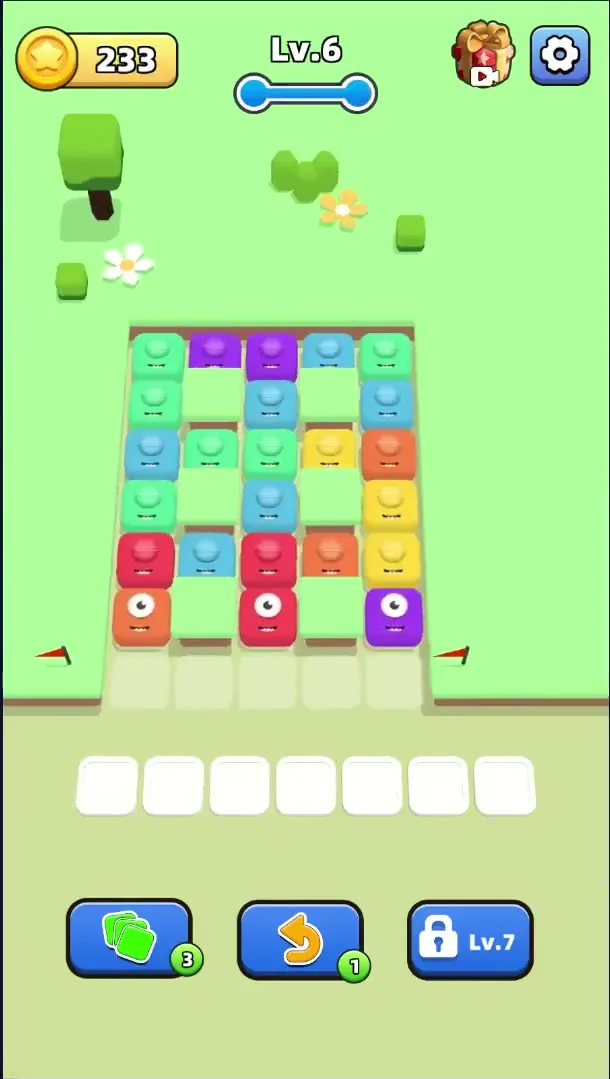
The only booster put to use is the undo, a yellow curved arrow in the second slot. On the first field of Level 6 the tray held six blocks, a pair in each of three colors. One use of the undo lifted the last red out of the tray and set it back on its spot on the field, leaving five, and the button’s badge dropped from 3 to 2. By the time the tray filled, it read 1.
From grass lanes to a seven-color cross
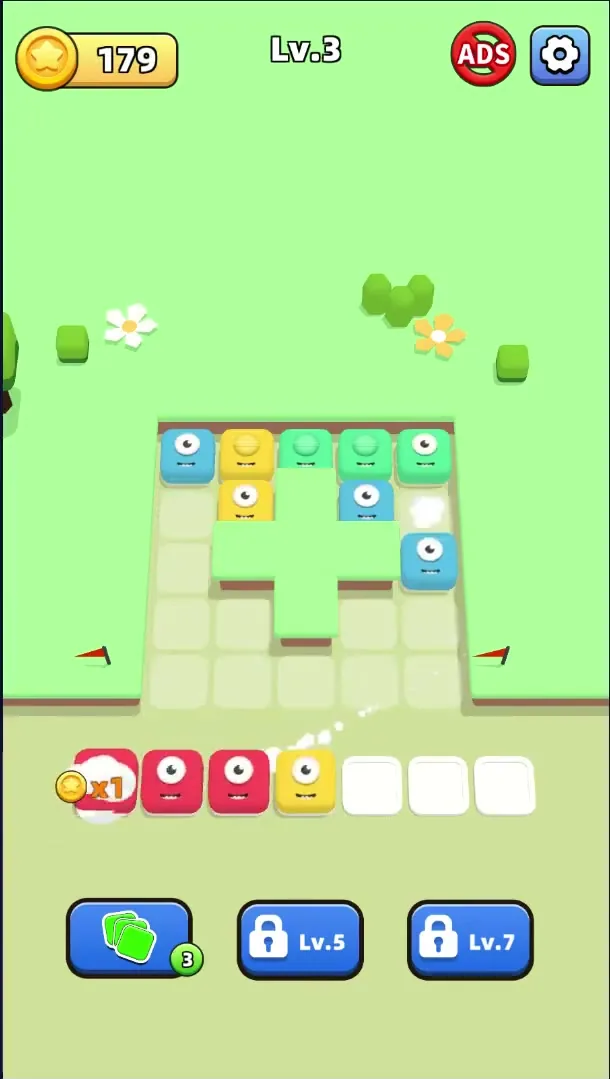
The shape of the grass changes on almost every level. After the lanes of Level 1, the field of Level 2 opens into a single area five tiles wide. Level 3 then sets grass inside that open field for the first time, a plus shape in the middle. The same level opens the first booster slot, a stack of green cards.
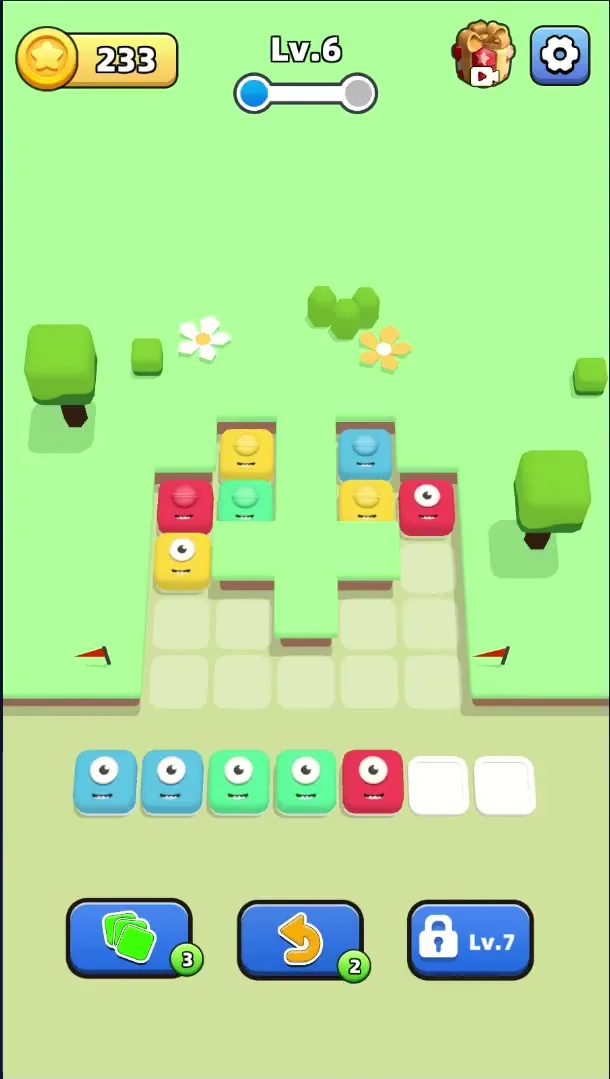
Grass splits the upper field into two pockets in Level 5. A strip runs down the center from the top edge, crossed by two bars, so one pocket sits on the left and the other on the right. The same level unlocks the second booster slot, the undo.
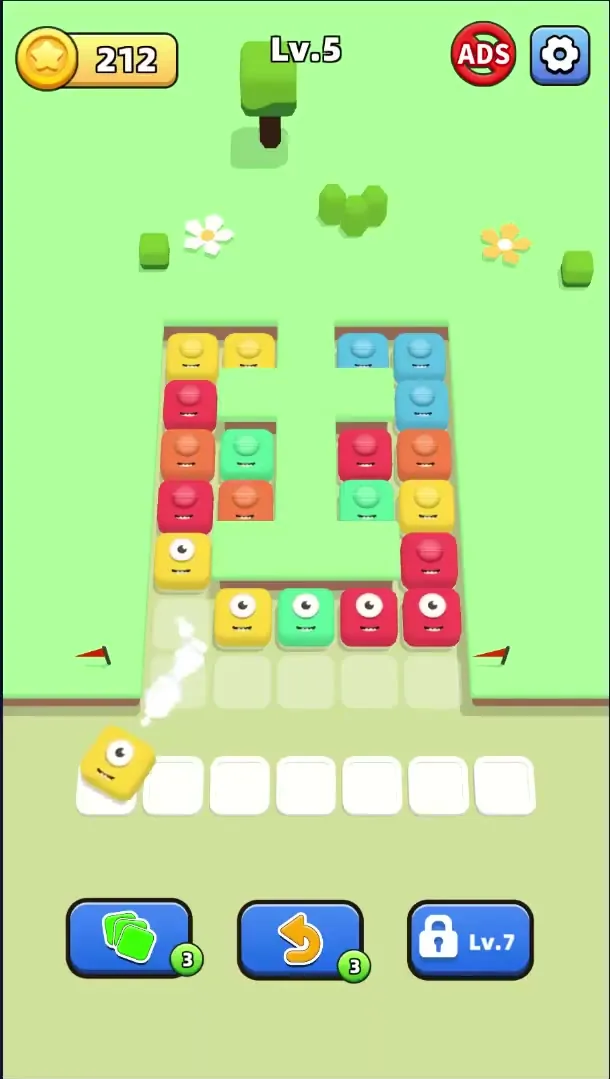
From Level 4 on, most blocks start a level asleep. Early in Level 5, only the yellow at the foot of the left column and a row of four under the lower crossbar are awake. The second field of Level 6 and the first field of Level 7 each open with just three awake blocks, all on the bottom row.
Colors pile up along the way. Level 1 uses three and Level 2 uses four. Orange arrives as a fifth color in Level 4 and purple as a sixth on the second field of Level 6. The second field of Level 7 holds seven, with a new dark green placed beside the lighter mint green.
Level 6 is also where a level first comes in two parts. A two-dot progress bar under the level number tracks them: the first dot is blue on the first field, and both are blue on the second. Level 6 opens on a plus of grass again, then switches to a full grid five columns wide, with grass squares in its second and fourth columns on every other row.
Level 7 follows the same two-field pattern. Its first field narrows until only a three-tile row opens at the bottom between grass corners. Its second is a taller cross: narrow at the top around one grass block, widest across the middle, then four columns around a second grass block above a four-tile bottom row. The camera pulls back to fit it in, and the third booster slot, blue circular arrows, has been open since the level began.
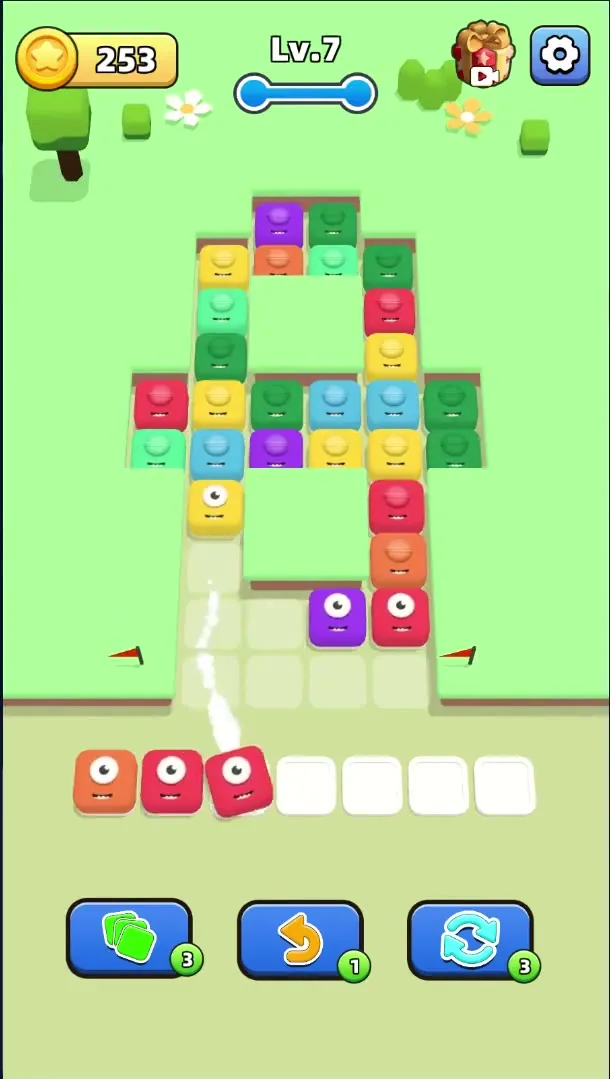
Outside the field, the booster bar is the first extra. All three slots start padlocked and marked “Lv.3”, “Lv.5” and “Lv.7”, and each opens on that level with a badge reading 3.
Coins are the only currency on screen. The counter at the top left rises between levels, by the amount on the reward screen, and holds still while sets clear during play. Each clear flashes a coin with a multiplier over the tray: “x1” in Level 3, then “x2” and “x4” in Level 7. A finished level closes on a red-ribbon “WELL DONE” screen, where a glowing pile of coins and an amount (“x16” after Level 2) sit above a single green “Claim” button.
When the tray fills, the “NO SPACE LEFT!” panel shows three blocks being swept out of a tray under the line “Back three objects”. It offers this through either a yellow “Revive” button marked with a camcorder icon or a green button showing a coin and “100”, and an X closes the panel. A second view of the panel reads “You will lose 1 life” over a broken heart, and no lives counter appears anywhere else.
The top bar changes as the levels go by. From Level 2 through Level 5 a red round “ADS” button sits beside the settings gear, and from Level 6 a gift box with a small red camera badge takes its place. Neither was tapped, and no ad appeared between levels or after the fail panel.
Sleeping blocks in place of stacked layers
The praise goes to how Jam match 3D handles hidden pieces. A triple-tile matching puzzle splits its pieces into ones you can take now and ones kept out of reach until others move, and Sheep a Sheep does that with layers. Here the split survives, drawn with eyes and terrain instead: a lid marks a block that isn’t available yet, and grass takes the place of the tiles that used to sit on top. We found that very clever.
The boxed-in red on Level 7’s first field shows the idea plainly. In a layered game it would sit under another tile; here turf on three sides keeps it asleep while blocks in the outer columns wake around it.
There is a larger point behind the swap. Jam match 3D shows one way to strip a hit game down to its core rules and rebuild it. The tray, the sets of three and the split between open and hidden pieces all stay, and only the map that delivers them changes. The longer that is turned over, the more unsettling it gets, and it lands close to a mashup of a 3D triple-match puzzle and a triple-tile matching puzzle that we covered earlier, which reached a similar place by a different road.
Unused boosters and lives without a counter
We have no criticism of the game to report. A few parts of it simply stay out of view in these levels.
Only the undo was ever used, so the green card stack and the blue circular arrows never showed what they do. The fail panel warns about losing a life, but how many lives a player holds, and what losing one costs, is not shown. Nothing past Level 7 is covered here.
Reading a lawn before each tap
Each field asks for the same small routine: find the few open eyes and work out which neighbor will wake which sleeper, all while keeping the tray from filling with colors that have no partner yet. It is a puzzle of order rather than reflexes, with no clock running and every move a single tap on a block that is already awake.
People who know the layered formula will recognize the tray and the threes, then find a different board to read. Walls and lids, not stacked tiles, decide what is available, and each new field arrives in a new shape.
Verdict
Jam match 3D takes a familiar formula and changes one thing: how a piece becomes available. Closed lids and patches of turf now do the hiding that overlapping layers used to do, and that substitution is ingenious. It also shows one way a hit’s core can be pulled apart and reassembled from new parts, in the same spirit as the 3D-and-tile mashup covered earlier. That thought grows more unsettling the longer it sits.