Puzzle Rumble Review: 25 Players, One Match-3 Board Each
Stone rows climb and rivals turn into tombstones in this Puzzle Rumble review of a 25-player match-3 battle royale with a 3D home yard.
Game at a glance
Puzzle Rumble
6/ 10
Our score
More and more games dress up as Animal Crossing. Nintendo rules; Genshin impresses.
In this article6 sections
A battle royale drops a crowd of players into one match and keeps going until only one is left. Puzzle Rumble blends that contest with the boards of match 3 games: 25 players each work their own 9×9 grid of colored creatures, and every rival’s board shrinks to a thumbnail at the edge of the screen. It plays in landscape on mobile, and a knocked-out player’s thumbnail turns into a tombstone.
On its own grid, Puzzle Rumble plays the way games like Royal Match do, with same-colored pieces cleared from the board. What changes is everything around that grid. Rival boards line both sides and attacks travel between players, while between matches there is a 3D home yard whose dressing takes after Animal Crossing. We played the closing seconds of one 25-player match, then a second match from its opening board until five players were left.
Clearing creatures while stones rise underneath
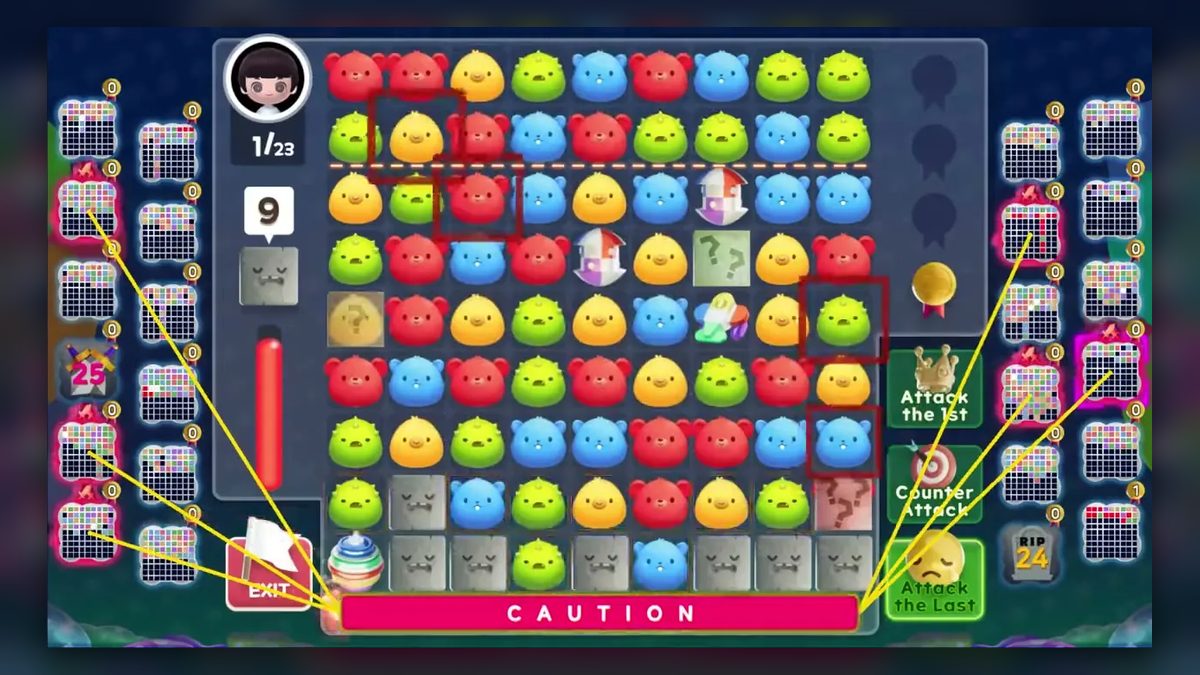
Every player gets the same kind of board, and the contest is to outlast the rest. A counter under the avatar keeps track of the field: its second number counts the boards still in play, the player’s own included, and drops each time a rival goes out. The board itself sits against a dark, starry backdrop.
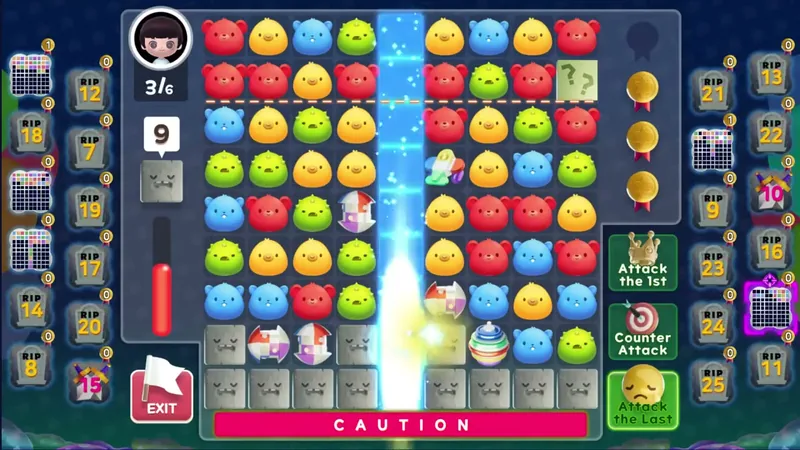
An EXIT button with a white flag sits at the lower left. To the right of the grid stand three green buttons: Attack the 1st with a crown icon, Counter Attack with a target, and Attack the Last with a sad face, which is drawn brighter, with a lighter border, all match long. Some creatures carry red square outlines or blue corner brackets, and at times yellow boxes outline cells in the bottom rows.
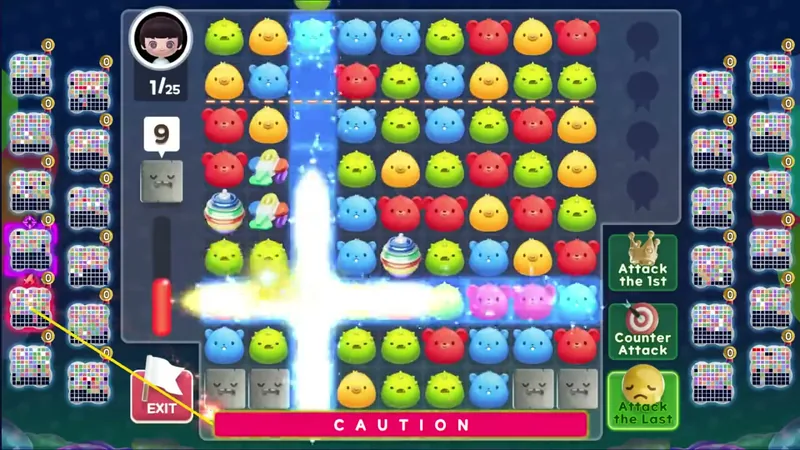
At its center, Puzzle Rumble gameplay means clearing same-colored creatures from the 9×9 grid. Bears come in red and in blue; the other two types are yellow chicks and green blobs with little spikes. Cleared cells flash blue with sparkles, often in straight runs of three. Big words pop up over the board now and then: Amazing in yellow with a purple outline, Great in light blue, Good in orange.
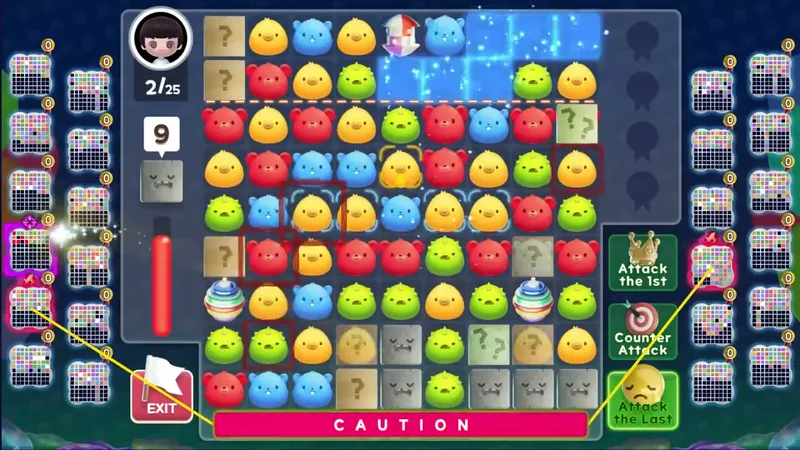
Three kinds of special piece turn up among the creatures. One is a rainbow-colored rocket and another a rainbow-striped spinning top. The third is an arrow-shaped piece in red and white with purple, some pointing up and others sideways.
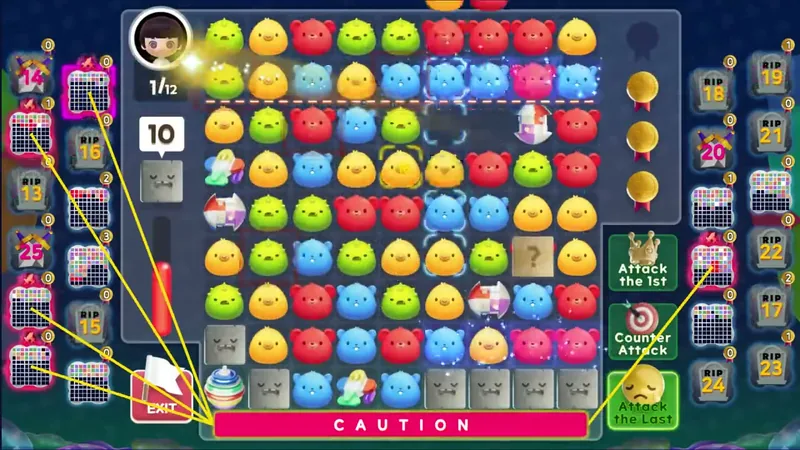
Bigger clears appear as effects that sweep the grid. A glowing beam can run down a whole column, or a streak along a whole row, and a cross hits a full row and a full column at once. A ring burst covers a roughly square block in the middle of the board. At one point a large part of the right side emptied all at once while streaks flew off to the right.
Square boxes marked with question marks fill single cells. Tan boxes carry one question mark, while the pale green and pinkish ones carry two. They turn up among the creatures and, later, among the stones too.
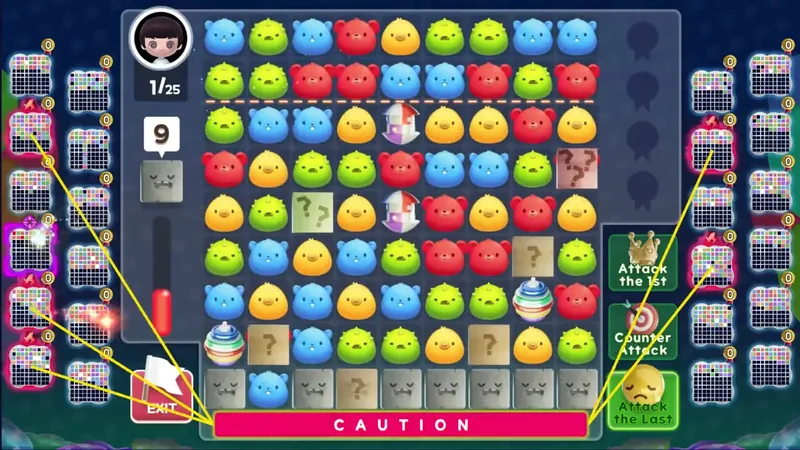
Gray stone blocks with sleepy faces fill cells from the bottom of the grid. At one point a full row of them lined the bottom edge, and moments later the board had no stones at all. Groups of stones sometimes glow light blue or lavender. Left of the board, a box with a number points to a stone icon, and below it a red vertical gauge changes its fill as play goes on.
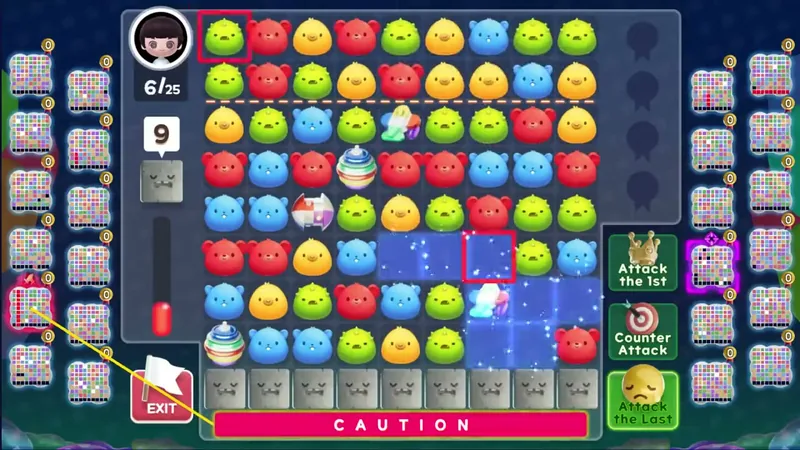
Attacks leave the board as glowing yellow streaks. One rival thumbnail at a time sits inside a magenta border with a small target icon above it. The border moves around, marking a board on the right and later one on the left.
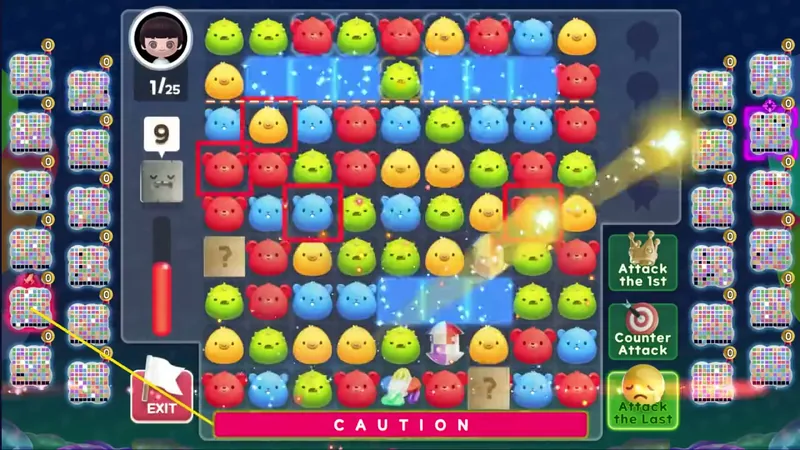
Lines also run the other way. A rival thumbnail glows pink, and a yellow line links it to the pink CAUTION bar under the player’s board; at one point five lines met there, three from the left and two from the right, and later in the match even more. A dashed orange line crosses the grid just below the second row.
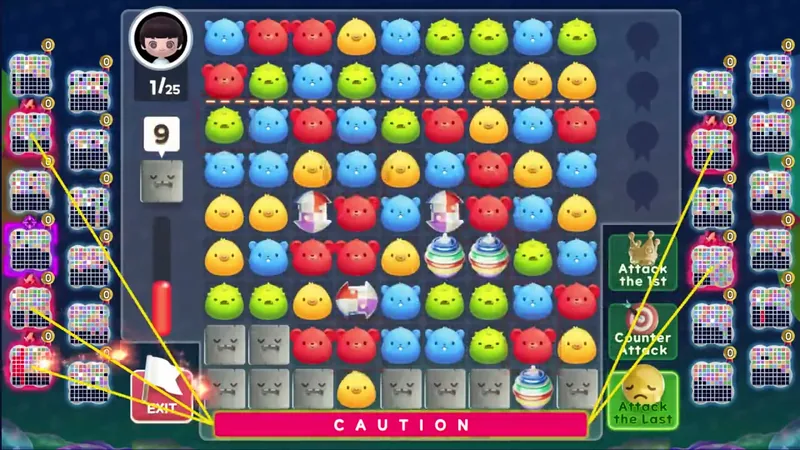
Knocked-out rivals leave different markers. Most are gray RIP tombstones with a number; some read RIP KO in pink letters, and others show crossed swords over a pink number. Beside the grid are four ribbon-medal slots, which filled with gold medals one by one during the second match, and every rival thumbnail wears a small medal badge with a number of its own. Late in that match, gold coin icons appeared over the avatar spot and over one rival board.
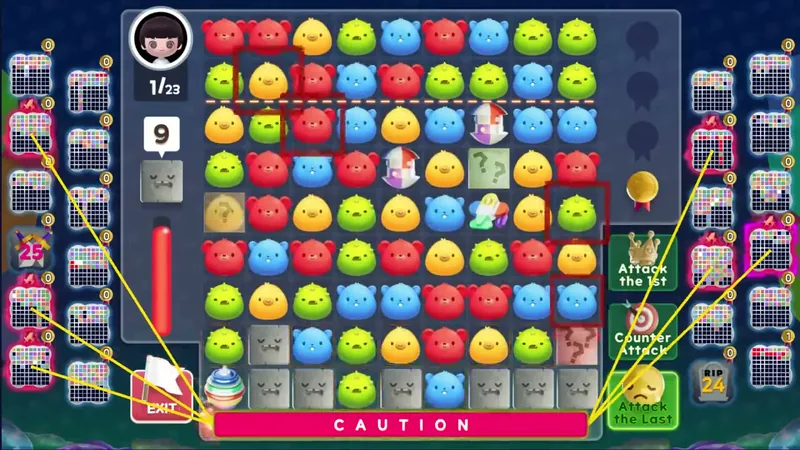
Tombstones and crossed-sword markers numbered 7 to 25 fill all but five rival slots in the closing seconds of the first match. Stones cover much of the bottom two rows and three of the four medal slots already hold gold, while a beam runs down one column and a pale green ‘??’ box sits near the top-right corner. Seconds later, that match is over.
From a clean grid to a red backdrop
Nothing but creatures sits on the grid when the second match begins. First the rival avatars fly into the side slots over a darkened board, each the same chibi face with a dark bob, framed by rings in several colors. Then the board lights up, flanked by 24 rival thumbnails in four columns of six, with all four medal slots empty.
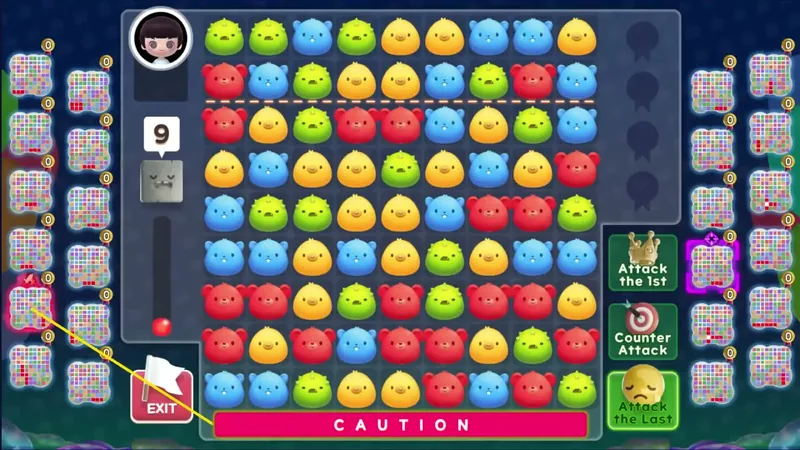
Extras pile in from there. An arrow piece is the first special to show up. Question-mark boxes and stones join soon after, and in the late stages every kind of special shares the grid with the boxes. Incoming lines multiply as well, from a single line at the start to five and more at once.
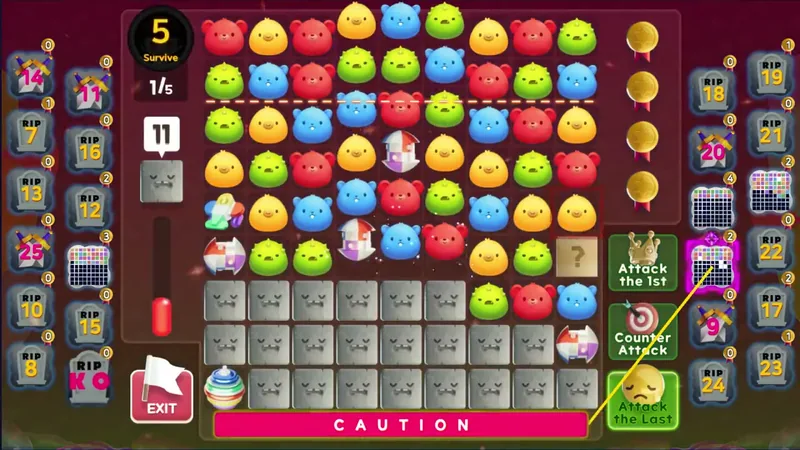
Stones keep returning from the bottom, and they climb. A single full row gives way to most of the bottom two rows and then to most of the bottom three. Near the end, the number in the box beside the stone icon ticks up twice.
Knockouts come slowly at first and then in a rush. Once they pick up, the boards still in play drop from 23 to 6 in quick succession, through 19 and then 12, while the medal slots fill with gold. With five players left, a Survive badge marked 5 takes the avatar’s place and the backdrop around the board turns dark red.
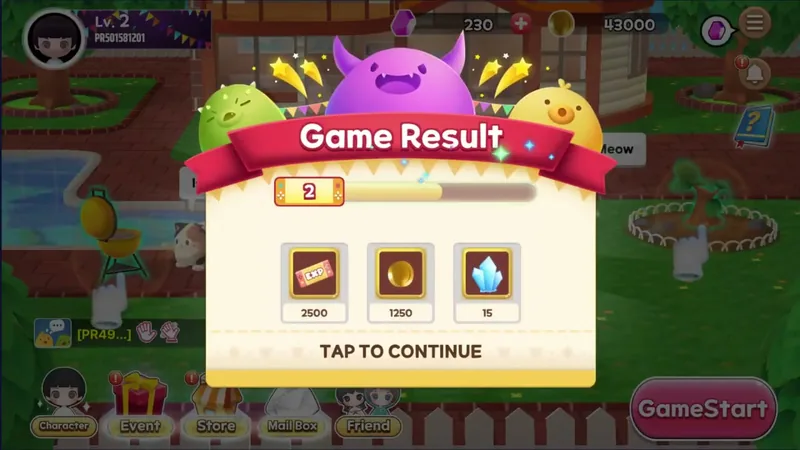
The progression between matches starts at the result screen. After the first match, a Game Result panel with a numbered bar lists three rewards, led by an EXP ticket worth 2500; the other two are 1250 coins and 15 crystals. A TAP TO CONTINUE prompt sits underneath, and the panel names no placement. An Unlocked pop-up follows with the line “Easy Mode (Single) has been unlocked.”
The home screen is a 3D garden with a house and a swimming pool. A calico cat sits at the pool’s edge near a yellow kettle grill, and across the yard a tree grows inside a small fenced circle. White pointing-hand icons sit next to the grill and the tree, and a speech label reads Meow. The player’s level shows next to the avatar at the top left.
A Production Object panel spells out what the yard makes, with the line “Different items are produced by each Object” along its bottom edge. A plant pot leads to a pouch of colorful items and the tree to a gold box full of them, while the grill makes a gold coin.
The bottom of the home screen starts with Character and Event buttons, continues with Store, drawn as a striped awning labeled SHOP, and Mail Box, then ends with Friend; a large GameStart button sits at the right. The three middle buttons, from Event to Mail Box, each carry a red exclamation badge. The top right holds a bell icon and a question-mark book, with a menu icon beside them.
Two balances run across the top of the home and menu screens: purple gems, with a red plus button next to them, and gold coins. Light-blue crystals turn up as a third item among the rewards.
The Event & Package screen has two tabs, New Player Login Event and Daily Mission, plus a countdown to the event’s end. Each day on the login calendar pays two rewards. The first day, already stamped with a ribbon-box badge, includes 30000 coins, and the second pairs a ticket ×5 with another 30000.
On the third day the pair is 700 crystals and a rainbow ticket ×10, and the fourth pays a gift ×3 plus 30000 coins. More days run past the right edge, above a banner that reads “Don’t forget to complete the Attendance Event! Get your Final Rewards before it ends!”
A SELECT GAME screen offers three cards with big creature portraits: SINGLE MODE, BATTLE MODE and PLAYING WITH FRIENDS. Because the player is on a guest login, a Notice pop-up suggests linking an account to keep the data safe. On the home screen, a chat line shows another player’s ID tag, PR49…, beside two hand icons. No ad appeared at any point, from the result screen through the home screen to the start of the next match.
Glossy creatures and a 3D garden
The artwork is handled better than in Sushi:pack and roll. The creatures are glossy and round with simple faces, and the stones get sleepy ones. The home screen is a bright 3D garden with chibi avatars, and the menus lean on large creature art, such as the purple horned creature above the Game Result banner and the big portraits on the mode cards.
Match-3 battles with less effort behind them
Next to that same game, the play shows much less effort. Still, for a studio that got its start putting a fresh coat of paint on tiny one-mechanic games, this is already a big step.
Matching while rival boards turn to tombstones
These mechanics speak to a taste for match-3 played against a crowd rather than against a level. The player clears one grid while two dozen thumbnails tick along at the edges and stones rise from the bottom. Lines arrive at the CAUTION bar, and three attack buttons carry labels that name a target, from Attack the 1st to Attack the Last.
Outside the matches there is a management layer: a garden whose objects produce items, next to a login calendar with daily missions. Light card elements are part of the design too, though nothing card-based turned up in either match.
Verdict
Puzzle Rumble looks better than Sushi:pack and roll and shows much less effort in how it plays. Coming from a studio whose roots are in reskinned tiny games, it still counts as a big step.
It also joins the growing line of games that wrap an Animal Crossing-style shell around their play, and it reminded us of the match-3 project Lilith Games built in that style. Our guess is that studios are quietly lining up to follow the road Genshin Impact took.