Tile Match Run Review: Tiles That Ride a Winding Track
Fruit and plant tiles travel out of a pipe along a winding track, and this Tile Match Run review follows them into a seven-slot tray.
Game at a glance
Tile Match Run
9/ 10
Our score
Good design makes you say 'brilliant', but above all 'why didn't we think of that?'
In this article6 sections
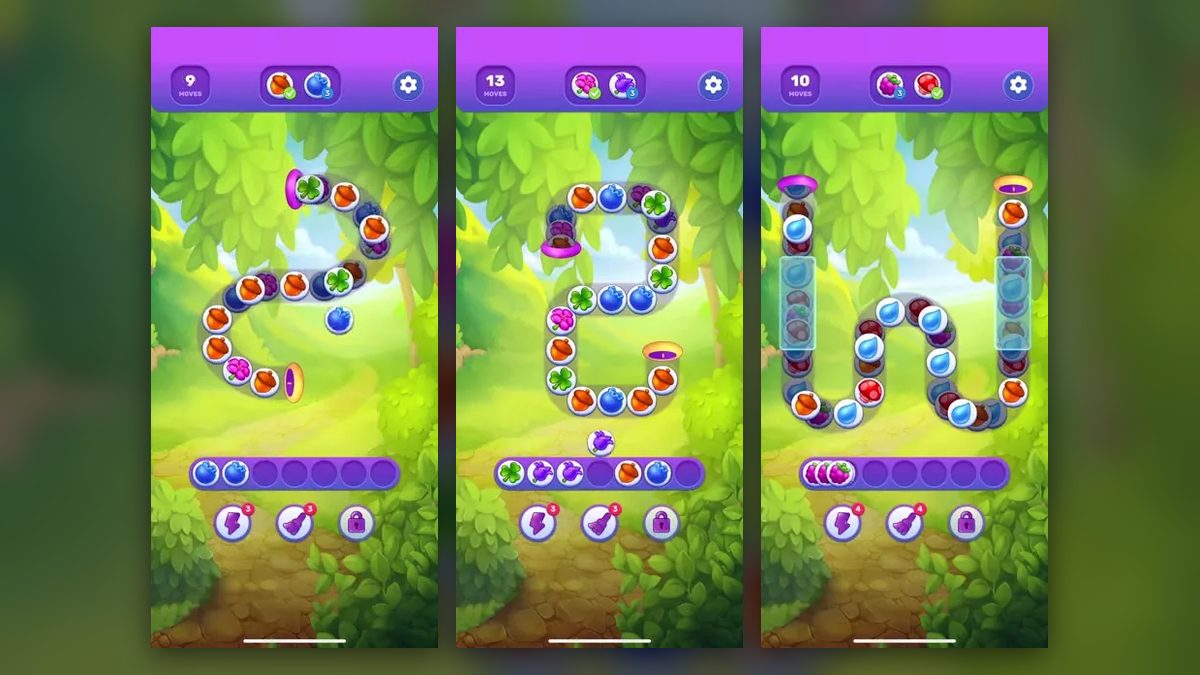
Pick a tile off a winding track and it flies down into a tray of seven slots, where three of a kind disappear. Meanwhile a magenta pipe feeds fresh tiles onto the track, and the line shifts along toward an orange ring at the far end. That is Tile Match Run, a mobile triple-tile matching puzzle that keeps the tray-and-threes rule of tile match games and sets the tiles themselves in motion.
Tile Match Run is the most innovative tile matcher we have seen, and its design craft is superb. Only the way the track is presented leaves room to improve.
From the magenta pipe to the seven-slot tray
We cleared Levels 1 through 9 and played the opening of Level 10, and every board follows one plan. A track runs from a magenta pipe to an orange ring with tiles lined up along it. The player picks those tiles off one at a time, and each picked tile flies down into the tray.
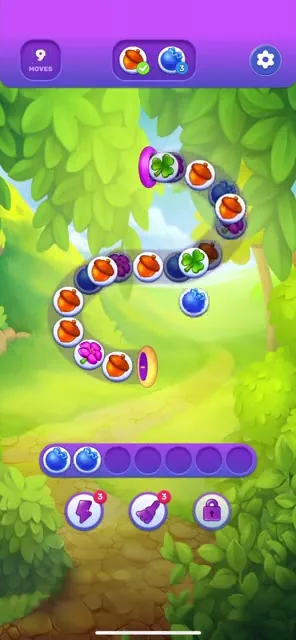
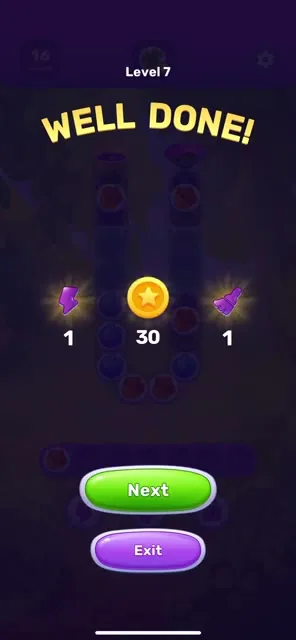
The goal panel sits in the middle of a purple bar across the top, between a “MOVES” counter on the left and a gear button on the right. It shows one or two goal tiles, each with a number, and every set of three goal tiles cleared in the tray takes 3 off its number as the matched tiles fly up into the panel. A goal that is met turns into a check mark, and once every goal has one, “WELL DONE!” arches over the dimmed board in yellow letters. A results panel follows with the level number and a coin reward above Next and Exit buttons.
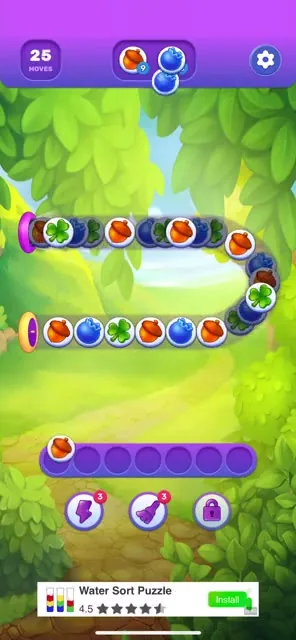
Acorns and blueberries share a short diagonal track in Level 2, with a goal of 6 of each and 25 moves to spend. Two sets of blueberries take that goal from 6 to 3 and then to a check mark, and the second set of acorns closes out the board.
Every pick spends one move, and Level 1 gives 15 of them. A red glow lines the edges of the screen when only a few moves remain (it was on at 5), and no board runs a timer.
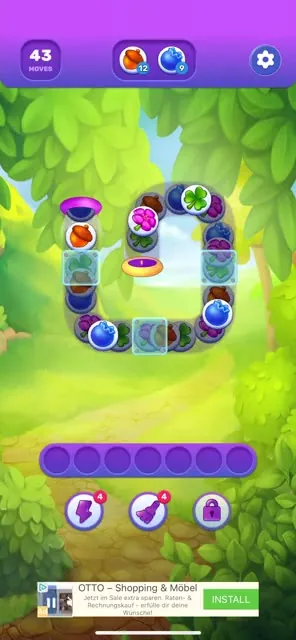
The track is a translucent gray band, and its whole outline shows while it is still empty. Tiles then come out of the pipe and spread along it before the first pick, with the next ones stacked at the pipe mouth. During play the line shifts away from the pipe: partway through Level 5, every tile on the bottom run moved about one tile-width to the right.

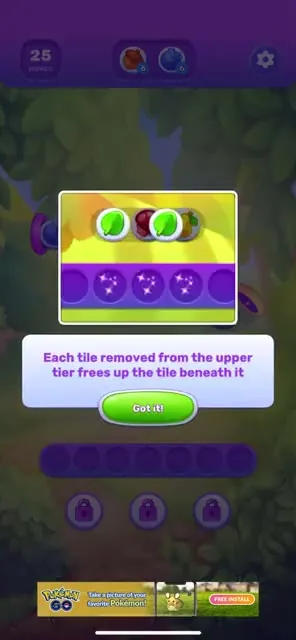
Tiles also sit in two tiers. The upper ones are bright icons on white discs, and darker tiles wait beneath them along the track. A tutorial card at the start of Level 2 spells out the rule: “Each tile removed from the upper tier frees up the tile beneath it.”
The tray is a row of seven round slots under the board. Three identical tiles in it vanish in a sparkle, and matching tiles end up side by side: with two purple flowers in place, a slot stays open next to them while a third flies in. In Level 5 the tray was caught with all seven slots filled, three of them blueberries.
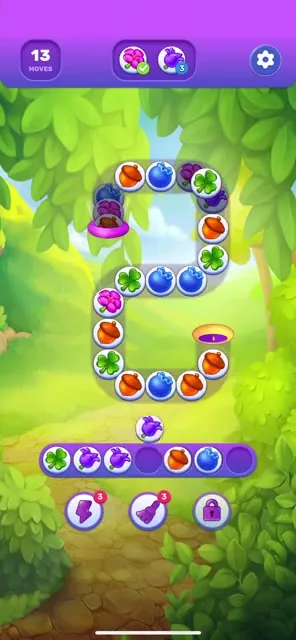
The tray rule is the one behind games like Match Factory, where 3D objects are picked out of a messy pile into a tray and three identical ones clear. Tile Match Run swaps the pile for a line of round tiles on the move.
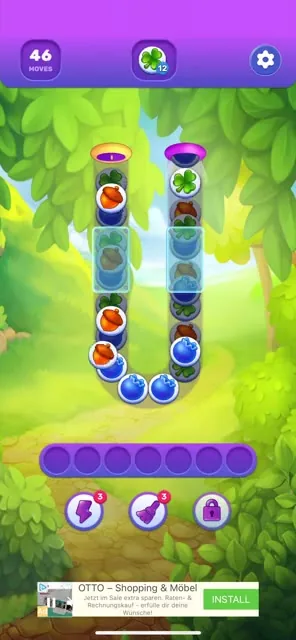
Glass panels, translucent blue-green rectangles, lie over sections of the later tracks. Tiles passing beneath them show through tinted, without the white discs of open tiles. What sits under a panel changes as the line moves: under the bottom panel of Level 8, a tinted acorn gave way to a tinted blueberry moments later.
Longer tracks and panels of tinted glass
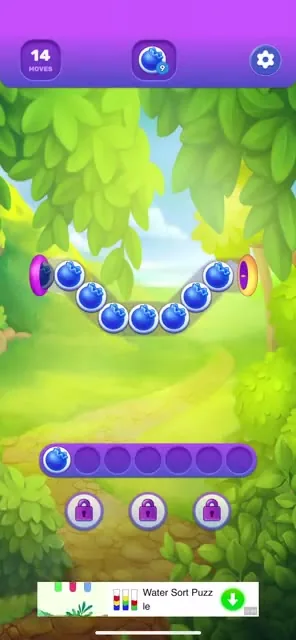
The tile set widens in steps. The first board holds nothing but blueberries in a single row along a short track that dips like a shallow V, with one goal of 9.
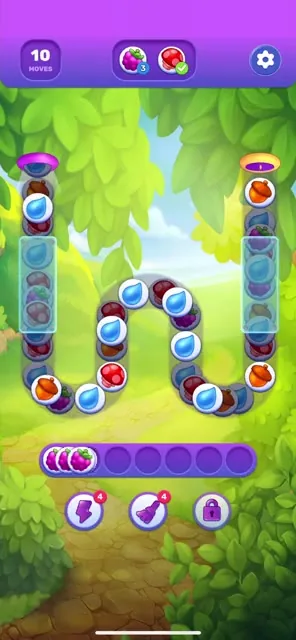
Acorns join in Level 2 as a second goal, together with the darker lower tier. Clovers and pink flowers mix into the line in Level 3 without counting toward its goals, while purple bell-shaped flowers turn up in Level 5. A different set takes over on the W-shaped track of Level 9, where purple grapes, red spotted mushrooms and blue water droplets share the line with acorns.
The tracks stretch out as well. The short diagonal of Level 2 gives way to an S in Level 3 and a U lying on its side in Level 4. The boards in Levels 5 and 6 wind along squared-off paths with several right-angle turns, and the one in Level 6 doubles back twice on its way to the ring.
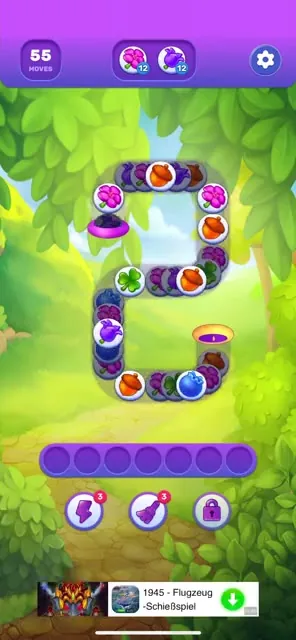
Goals and move budgets grow alongside. The S-shaped board asks for 9 acorns and 9 blueberries in 39 moves, while the sideways U raises each goal to 12 and gives 41 moves. Both goals stay at 12 in Levels 5 and 6, where the budget grows to 47 moves and then 55.
Glass panels first appear in Level 7, one on each arm of a U-shaped track, where a single goal asks for 15 clovers in 53 moves. Level 8 has three, on a track that loops down, across, up and back over the top before turning in to a ring in the middle. On the W of Level 9, two tall panels cover the outer arms, and the goals are 12 grapes and 12 mushrooms in 47 moves.
Every board before Level 10 sits in front of a cartoon forest with a dirt path. Level 10 switches to a desert canyon with red rock walls and cacti, and its track is shaped like a 2, with one glass panel on the diagonal and one on the bottom run. The goal there is 21 clovers in 96 moves.
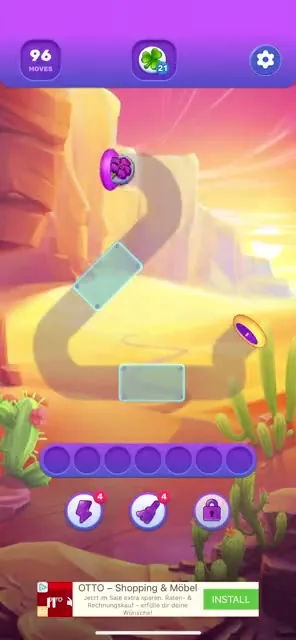
Three round booster slots sit under the tray, all of them padlocked in Levels 1 and 2. From Level 3 the first two hold a purple lightning bolt and a purple broom, each with a small red number badge, while the third keeps its padlock.
Results panels pay out coins, pictured as a gold star coin: 20 after Levels 3, 5, 6, 8 and 9, and 30 after Level 7. Clearing Level 7 also hands over one lightning and one broom, which pushes both booster badges up by one. No coin balance appears during play, and nothing to spend coins on came up.
The first attempt at Level 5 ended on an “OH, NO!” screen asking “Keep playing?” above small icons of the two goal tiles. A loading screen came next, and the level started over with 47 moves and both goals reset to 12. The second attempt cleared it.
A banner ad runs along the bottom of most play screens, for other games and brands such as Water Sort Puzzle and Pokémon GO, several of them in German. Results and loading screens carry no banner, and every ad seen was a banner. Between boards, a bush of leaves closes over the screen with a purple ribbon carrying a tip such as “Loading a brain-training session with colorful tiles”, then parts on the next board. No home screen, level map, shop or lives counter appears along the way.
Open and hidden tiles on a moving line
Everything around the track is standard for the genre, some of it even dated: a seven-slot tray, goal counters, a move limit, two boosters. Feeding the tiles out of a pipe and along a track turns those familiar parts into a brilliant experience with no precedent, the kind of idea that looks obvious only after someone else has had it. Games that pull this off with ordinary parts are the ones we especially like, and landing an idea like that is the happiest moment a game designer can have.
The moving track and the cover laid over it wring everything out of the genre’s mix of open and hidden tiles, and out of how fresh tiles reach the board. Bright tiles sit over darker ones and glass panels show tinted shapes that change as the line shifts, while the next arrivals wait in view at the pipe mouth before they slide out.
It also opens a new direction for tile matching, both in how it plays and in how far it can be taken. The track takes a new shape on every board, from the shallow V of Level 1 to the 2 of Level 10, and from Level 7 on, glass covers parts of it.
It is a masterwork of tile-match design, as far as we have seen, and its craft is superb enough to stand out at first sight. The art is very good too, from the glossy icons on white discs to the cartoon forest and the red-walled canyon of Level 10.
How the track is presented
The one shortfall, in our view, is how the track is presented, which still has room to improve.
A few other things stay open. Neither the lightning bolt nor the broom was put to use, so their effects remain unknown, as does whatever unlocks the third booster slot. Glass panels were also the only kind of cover laid over any track.
Choosing the next tile from a shifting line
Tile Match Run gameplay comes down to watching a line move along its track and choosing which tile to pull next, with one eye on the goal panel and the other on seven tray slots. Most boards set two goals at once, and a tile that counts toward neither still takes up a slot once picked.
From Level 2 on, much of each board is only partly in view: darker tiles under bright ones, a stack waiting at the pipe mouth and, from Level 7, tinted shapes behind glass. The taste these boards speak to is reading what is about to surface, with a move counter rather than a clock setting the limit.
Verdict
Tile Match Run takes very common, even dated parts and, by putting its tiles in motion, builds something that plays like nothing before it. That makes it a high point for design in the genre, with superb craft and very good art. How the track is presented is the one flaw in an otherwise excellent design.