Bunny Heist Review: Tile Matching Under a Bunny's Escape
Fruit tiles below, a caged bunny and a tiger's catapult above: a Bunny Heist review of a 2D tile matcher that adds story scenes to some levels.
Game at a glance
Bunny Heist: Tile Matching
7.5/ 10
Our score
3D tile matchers compete on graphics, 2D ones on how the play is staged.
In this article6 sections
Bunny Heist is a decent answer from the flat side of tile matching, at a time when one 3D tile game after another has left the 2D ones looking a little outmatched. At heart it is one of the tile match games, a triple-tile matching puzzle in which fruit tiles move from a board into a tray and vanish in threes.
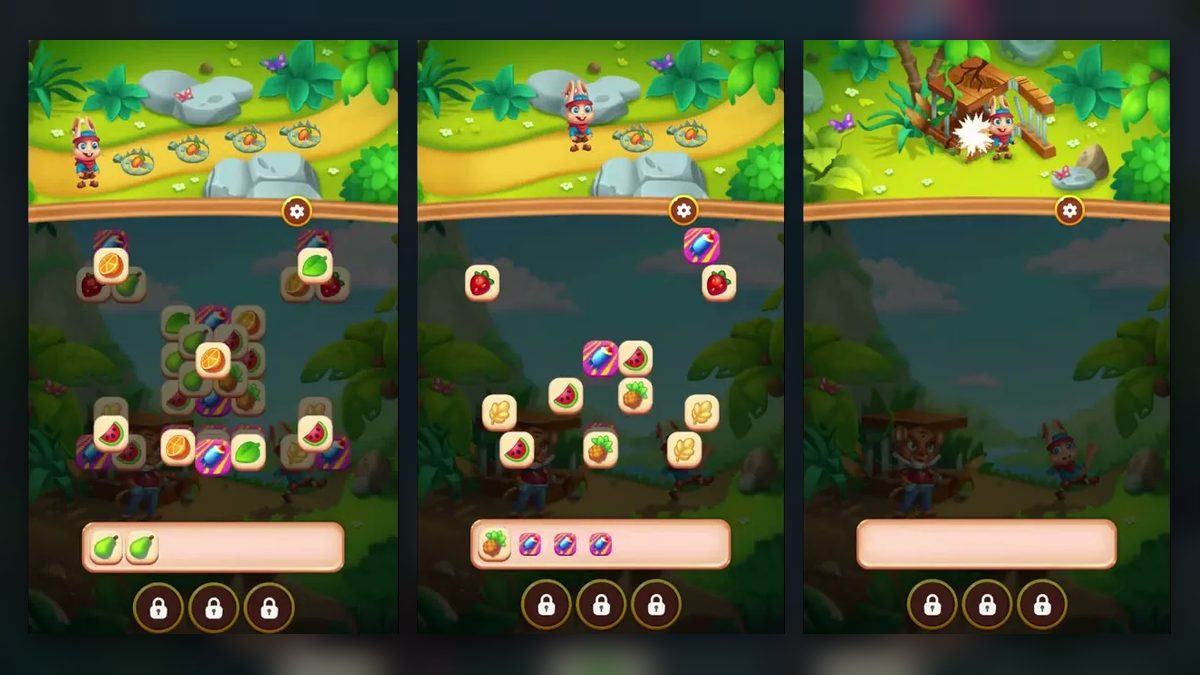
The difference sits above the board. In some levels a story panel shows the bunny breaking out of a tiger’s cage, walking a path of carrot traps or hiding behind a shield from the tiger’s catapult. We played Levels 2 to 8, and three of those seven carry a scene; the other four keep a bunny portrait above the board instead.
Fruit tiles in a long tray, scenes on top
Every level we played has the same goal: clear every tile from the board. The player picks uncovered tiles one at a time, and each one slides into a long tray bar under the board, filling it from the left. Three identical tiles in the tray disappear together, crumbling into gold or turning into glowing rings. Picking continues until the board is empty.
The tray is a single rounded bar with no slot markings, and no more than four tiles were seen in it at once. Plain levels show no move counter and no timer. Their settings gear is tucked into the top right, while scene levels put it on a wooden rail.
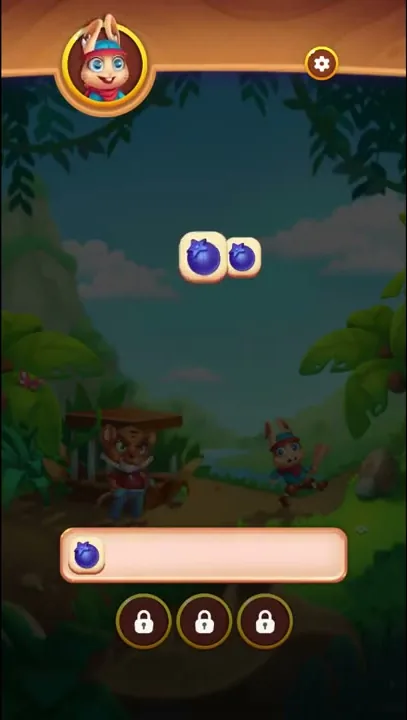
A small cross of tiles makes up Level 2, all in one flat layer: a row of three blueberries, a row of five below it alternating apples and bananas, a second row of three blueberries and a single banana at the bottom center. That is Bunny Heist gameplay at its plainest, with three fruit types and nothing stacked. Near the end, one blueberry sits in the tray while its two partners are the last tiles on the board.
From Level 3 on, tiles overlap. A covered tile is drawn darker than the free tiles above it and shows in full once they are gone, as with the pink striped tiles tucked under the two bottom lemons in Level 3. Early in Level 4 the board has a small pile in each corner and a block several layers deep in the center, plus a row of three tiles along the bottom.
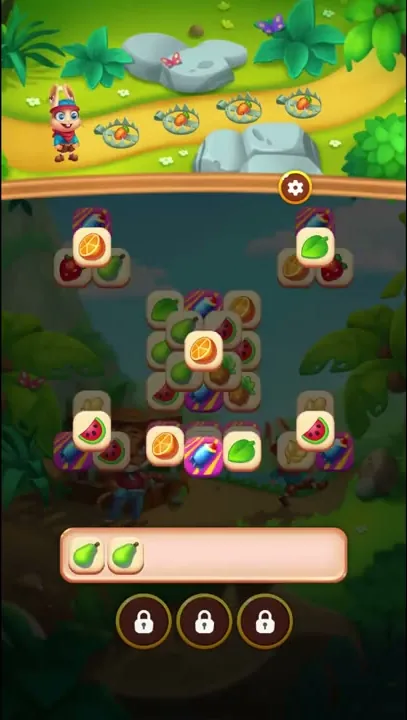
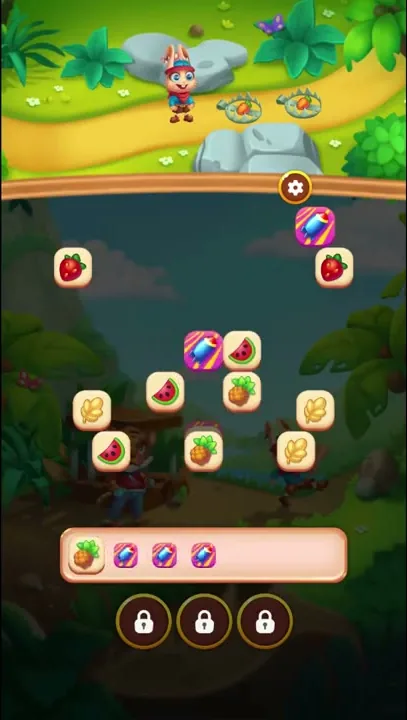
One tile looks nothing like the others: a pink-and-purple striped square, instead of a cream one, showing a blue, red-tipped object. It goes into the tray and clears in threes like the rest, and it turned up only in the scene levels. Midway through Level 4, three of them sit in the tray beside a pineapple.
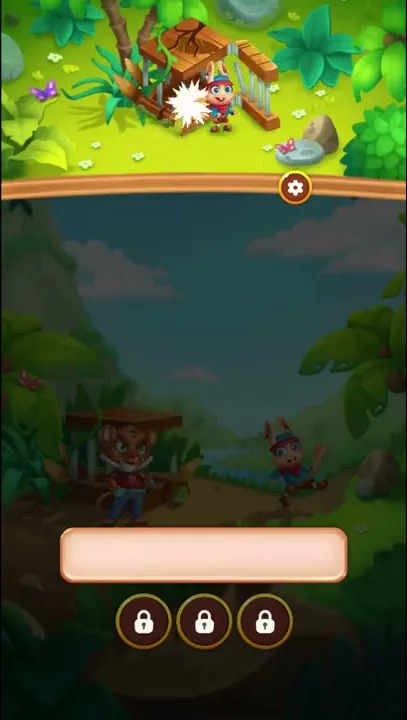
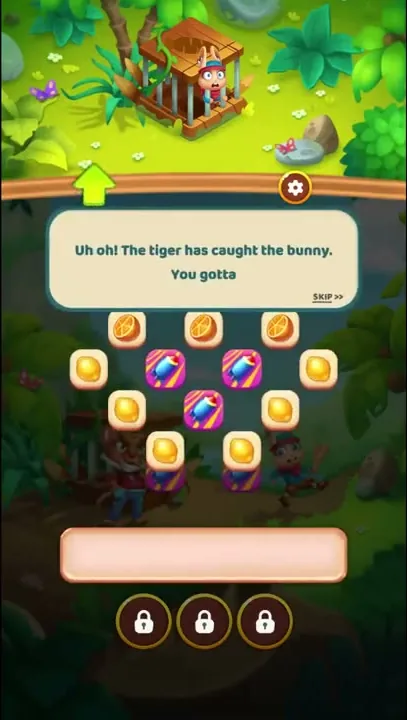
The first scene comes in Level 3, where a sunlit panel above the board shows the bunny locked in a wooden cage. Cracks appear on the cage roof while tiles remain below. When the last tiles go, the cage breaks apart in a white burst and the bunny stands free.
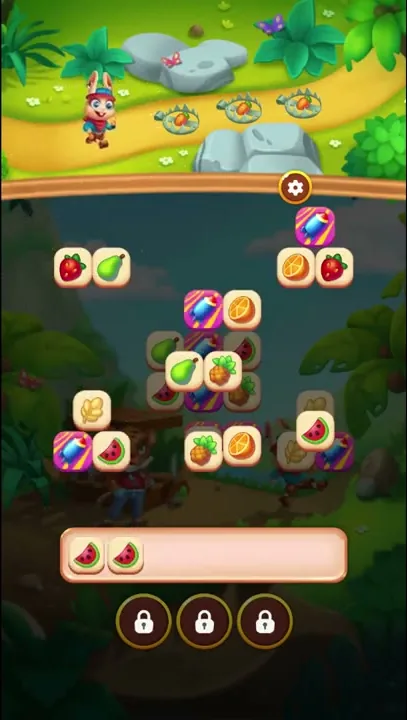
Level 4 swaps the cage for a dirt path, with the bunny at its left end and four traps ahead, each holding a carrot. As the board empties, the bunny walks right and the traps in front of it vanish one at a time. Three are left partway through, and the last one disappears just as the board is cleared.
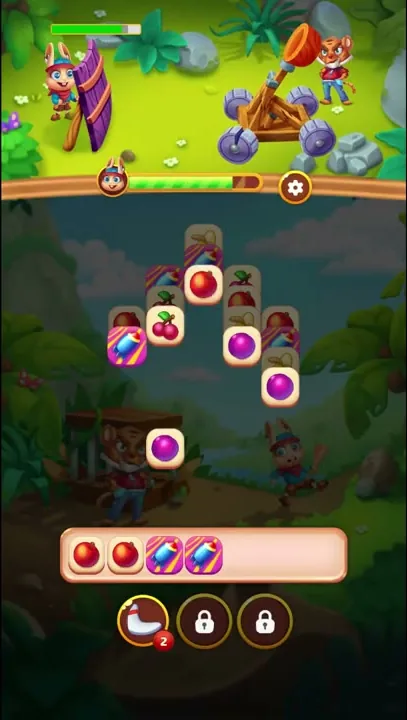
Level 8 turns the panel into a standoff. The bunny stands behind a purple wooden shield with a green bar above it, facing a tiger beside a wheeled catapult that has an orange cup on its arm. A second bar with a bunny-head icon runs along the rail under the scene; neither is labeled, and both shrink from the right as the level goes on. Later, a burst covers the catapult and leaves its parts looking scattered.
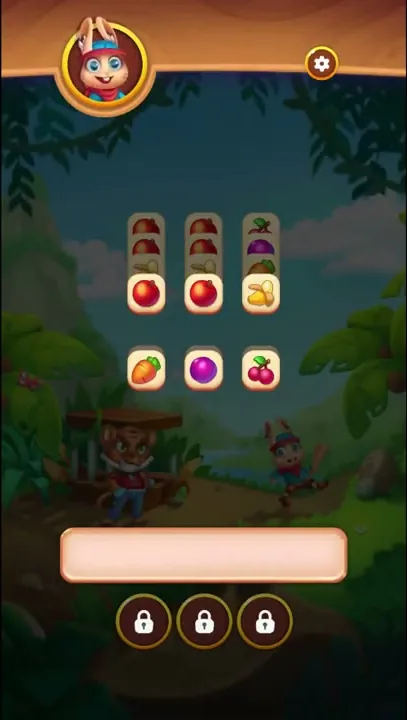
The art is bright cartoon jungle, with the bunny in a headband and scarf and the tiger in a red shirt. Most tiles are flat cream-colored squares with rounded corners, each carrying a fruit, vegetable or leaf icon, and the whole game is drawn in 2D. Plain levels set the board over a dimmed backdrop of the tiger beside a cage and the bunny holding a bat, a picture shown in full color just before Level 4’s tiles appear. The bunny portrait at the top changes expression during play, laughing with its eyes shut near the end of a board.
From a flat cross to stacked columns
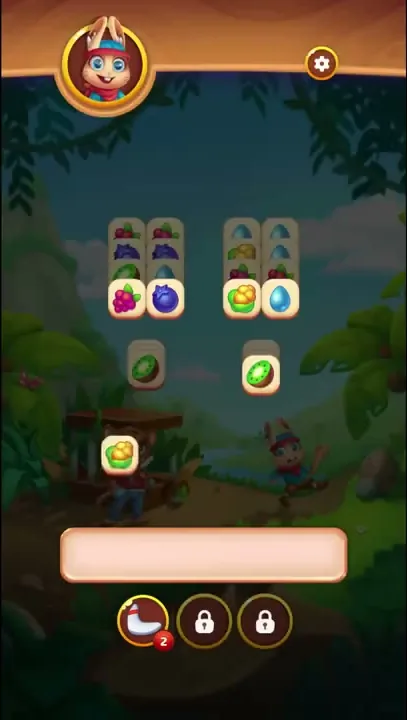
As the levels go on, the boards move from a single flat layer and overlapping piles to stacked columns, where only the front tile shows in full and the ones behind it peek out as strips. Level 6 opens with three such columns, each four tiles deep, above a row of three single tiles. Two pairs of columns sit over two short kiwi-topped stacks in Level 7, and the Level 8 board is an arch of five columns with the tallest in the middle.
Scenes appear in Levels 3 and 4, then return in Level 8. Those levels split the screen in two, with the sunlit scene and a wooden rail on top and the board and tray below, while the levels in between go back to the plain layout with the portrait. The cage and the standoff both open with a story box whose text is still typing out (“Uh oh! The tiger has caught the bunny.” in the cage level), with a SKIP link in its corner and a green arrow on the rail pointing up at the scene.
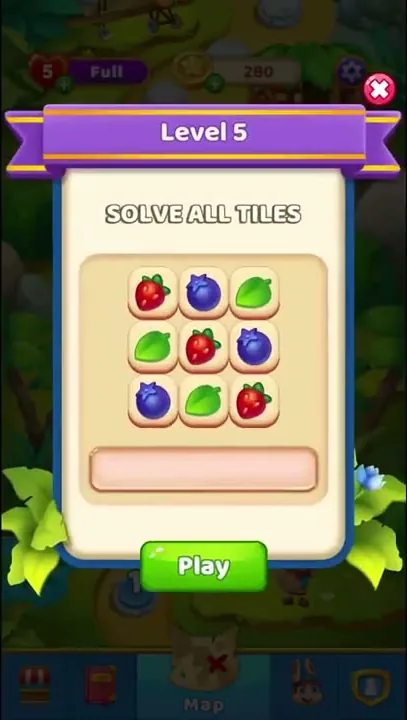
A card titled “Level 5” pops up over the map before that level, giving the goal “SOLVE ALL TILES” above a three-by-three preview of fruit and leaf tiles. A green Play button sits at the bottom of the card, with a red close button at its top corner.
Three round slots sit under the tray, and through Level 6 all of them show padlocks. In Level 7 the first one shows a white item icon with a red badge reading 2 instead, while the other two stay locked. The item stays unused through Level 8.
Outside the levels, the map holds the meta features. At its top left, a heart with a green plus button sits next to a bar reading “Full”, which never changed on any visit to the map. A coin counter with its own green plus button sits beside it.
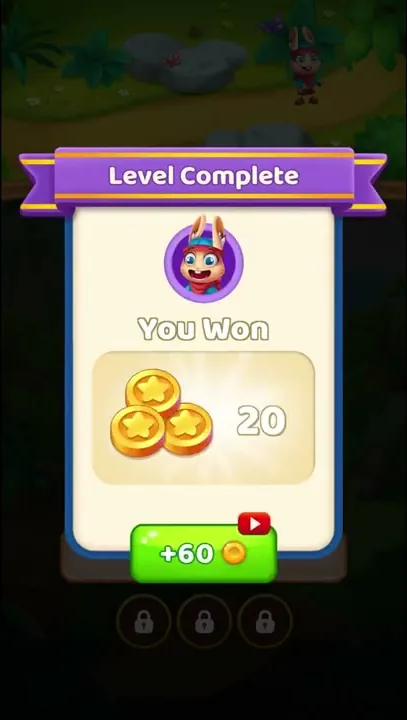
Both Level Complete cards we saw read “You Won” and awarded 20 coins. Under each sits a green “+60” button with a coin icon and a small red play icon; it was never pressed. Back on the map after a win, a pile of coins flies across the path.
The map is a winding jungle path of round numbered nodes, blue up to the next level and gray beyond it, with a hot-air balloon carrying the bunny over the next node. Along the path stand a caged bunny, a trap holding a carrot and a tiger beside a wheeled catapult, the same set pieces as the scenes. A treehouse rises near the top and a biplane sits at the top edge, while a pond with a lotus flower lies by the first nodes.
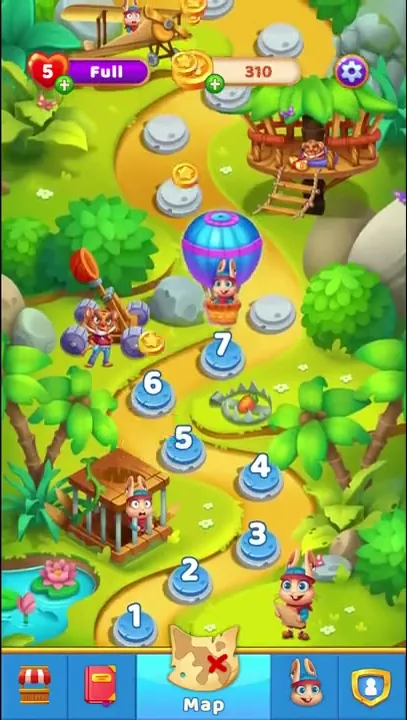
Five buttons run along the bottom of the map: a market stall, a red book, the highlighted Map tab, a bunny head and a blue shield with a person icon. None of them was opened.
Mini-game scenes woven into tile clearing
Bunny Heist is a mashup of tile clearing and small mini-game scenes, set inside a fight between a bunny and a tiger. Each scene level puts a different story beat over the same kind of fruit board, and in the Level 8 standoff the fight is out in the open, with the bunny behind its shield and the tiger at the catapult. That counts, more or less, as an original take on tile matching.
3D tile games compete on graphics, while 2D ones compete more on the visual treatment of the play itself, and each side has its own advantages. Bunny Heist keeps its tiles as flat cream squares and puts its effort into what happens around them, from the cracked cage roof to the carrot traps vanishing one by one.
An unused item and two unlabeled bars
We have no criticism of Bunny Heist to report. What follows are gaps in what the levels showed, not faults.
No fail screen appeared and the hearts stayed full, so we can’t say how many tiles the tray holds or what costs a life. The item in the first slot was never used, and the four other buttons on the map’s bottom bar were never opened, so no shop screen appeared either.
The scenes change as the board clears, but which matches drive each change is not shown. Level 8 was also left unfinished, with its two unlabeled bars still shrinking.
Clearing piles to move a bunny along
Most of the time goes into picking free tiles off piles and stacked columns and clearing them from the tray in threes, with the darker tiles beneath showing in full as each layer comes off. That loop suits a taste for working a board down layer by layer.
In the scene levels the same picking runs beneath a small story, a bunny freed from a cage or walking past carrot traps, and that side of the game speaks to a taste for puzzles with a story thread. The plain levels in between keep to the board alone, with the bunny portrait reacting at the top.
Verdict
With 3D tile games crowding in, Bunny Heist answers from the flat side: the tray rules stay untouched, and a bunny’s escape from a tiger plays out above the board. That makes it a respectable 2D entry, resting on an idea new enough to count as fresh.