Cut and Match Review: Rope Cuts Feed a Seven-Slot Tray
A Cut and Match review: ropes hold colored blocks, a cut drops them into a seven-slot tray, and three of a color burst into shards.
Game at a glance
Cut and Match
8/ 10
Our score
A little thin and not fully built out, but that's an open door for other studios.
In this article6 sections
Rope-cutting puzzles are about picking the spot where a snip sends things swinging and falling. Tile matching with a small tray is about gathering three of a color in a short row of slots. Cut and Match, a portrait-mode mobile puzzle, crosses the first with the second and sits among the tile match games. The difference is in how its tiles reach the tray: they hang from ropes and fall in when a rope is cut.
In the first nine levels we played, the two halves came together as more than the sum of their parts. The game is still a bit thin, though, and not built out far enough.
Cutting ropes to fill a seven-slot tray
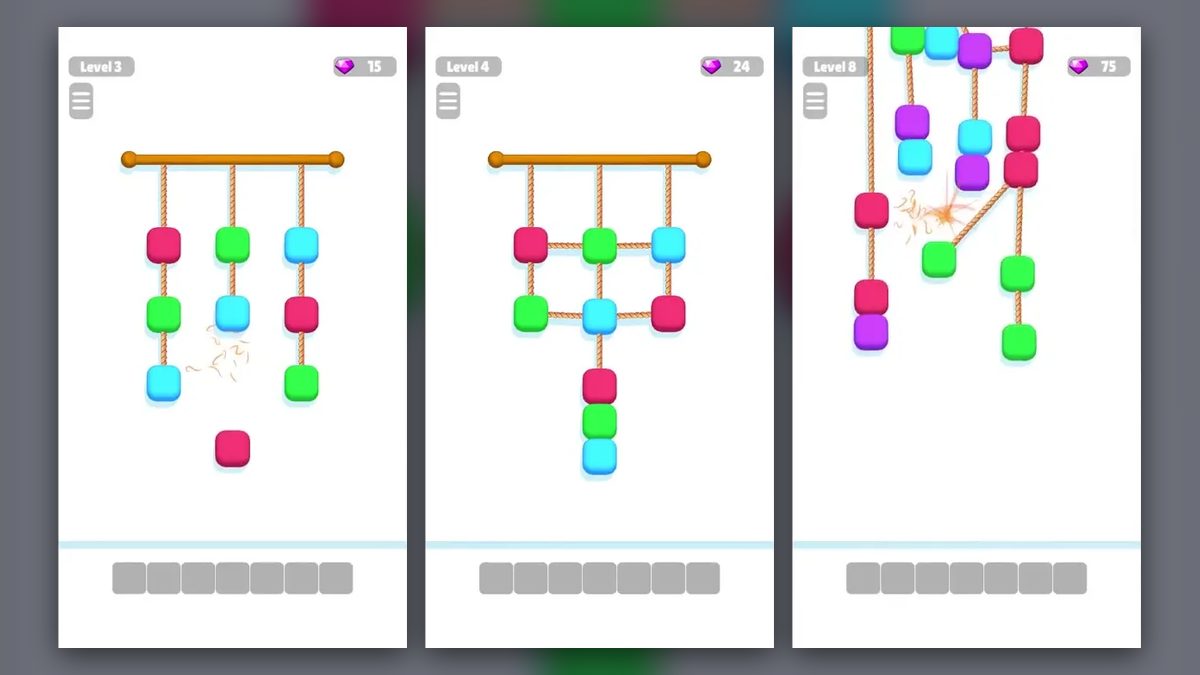
Each level hangs colored blocks from an orange bar near the top of a plain white screen. The blocks sit on braided tan ropes, some spaced out and some touching in groups, and the goal is to bring every one of them down. Once no blocks are left hanging, the board dims and a results panel takes over.
The player’s input is the cut. Each one shows as a small spray of frayed rope fibers where the rope parts. A cut can land just under the bar or on a rope between two blocks, whether that rope runs sideways or at a slant.
A cut drops whatever hangs below it unless another rope still holds it up, and touching groups fall together as one piece, while a linked structure that stays attached can swing to a new angle. The dropped blocks land in the tray at the bottom of the screen, and when three of one color are there, they burst into shards of that color and leave. That loop is the core of Cut and Match gameplay, repeated until the level is clear.
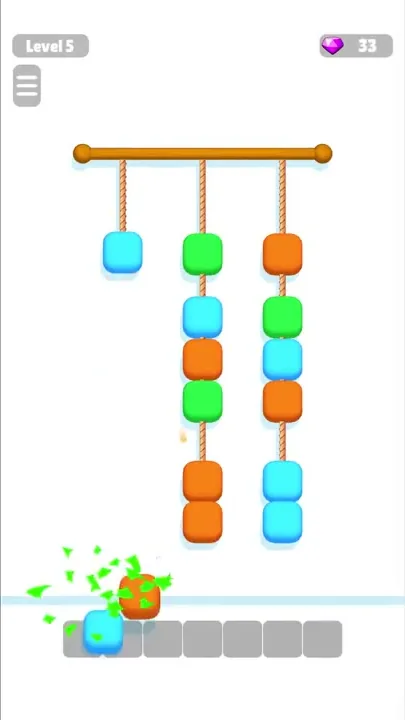
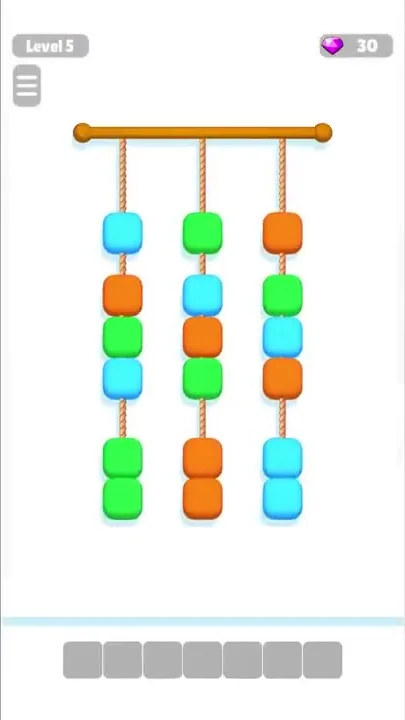
Three ropes hang in Level 5, each carrying a single block at the top, a touching group of three below it and a touching pair at the bottom. Cutting the left rope just under its top cyan block sends its group and its pair down together; three greens are among them, and green shards burst just above the tray as they land. Later in the level, the middle rope’s group of three drops as a single column while the tray holds two orange blocks plus one cyan and one green.
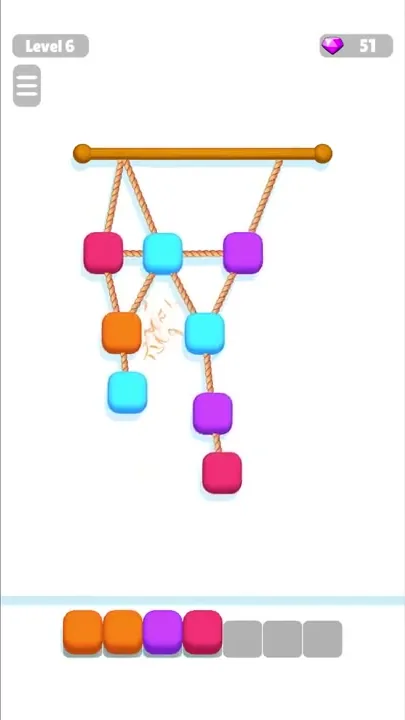
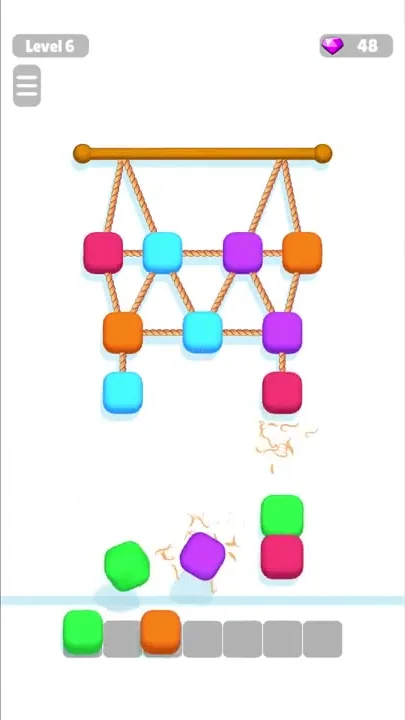
The tray is a row of seven gray slots under a pale blue line. It is the only limit on screen: in our session there was no moves counter, timer, lives, shop or booster button, and the tray never filled. A new block takes a place beside others of its own color: in Level 6 a second orange lands next to the first, and the purple and pink beside it each shift one slot along. Later in that level, purple shards fly and the tray is left holding two pinks and a cyan.
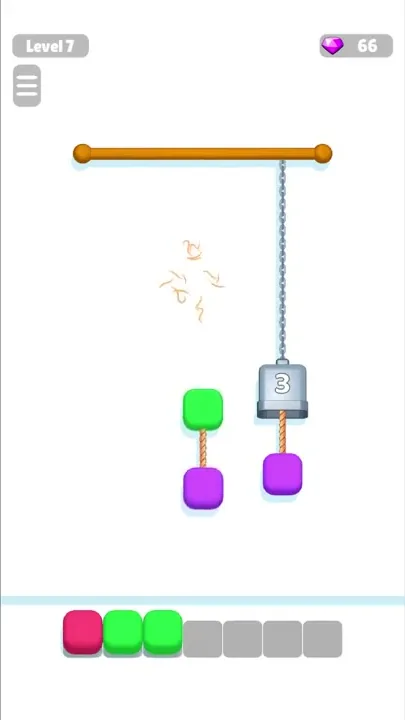
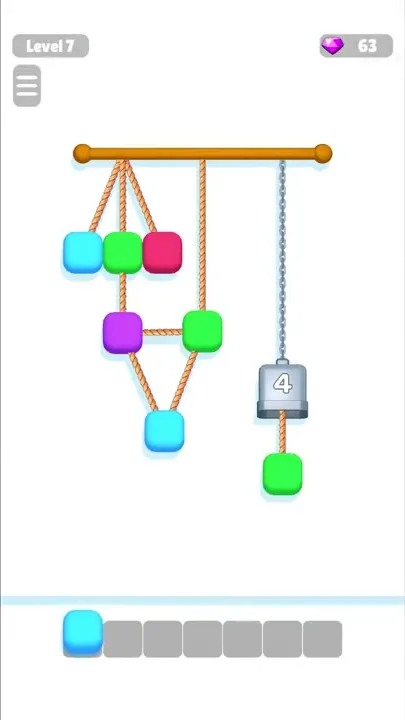
A gray metal box with a number on its face shows up in Level 7. It hangs from the bar by a metal chain rather than a rope, with a short rope below it holding one block. Early in the level it reads 4 with a green block underneath. Later it reads 3 with a purple block there instead, and near the end of the level it reads 0, with nothing below it and the box still on its chain.
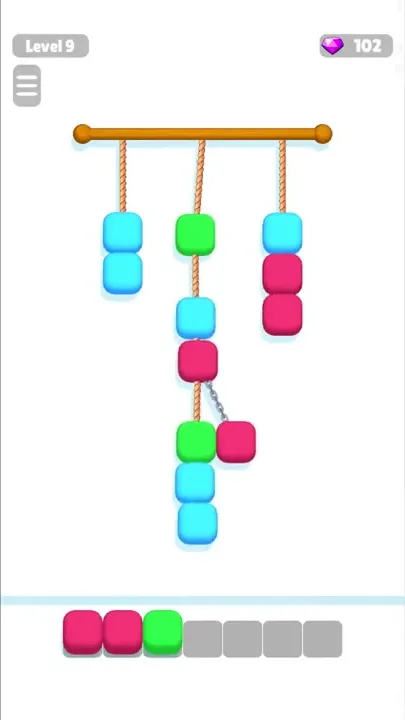
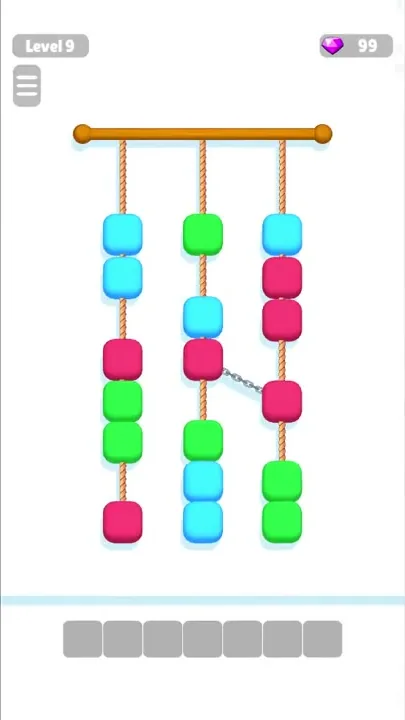
Level 9 has a short metal chain joining two pink blocks on neighboring ropes, one on the middle rope and one on the right. After the lower part of the right rope is gone, that pink hangs from the chain beside the middle rope. It is still dangling there after the rest of the right rope has dropped.
From single strands to chains and rope nets
The first layouts are plain vertical ropes. A single strand of three green blocks comes first, then three ropes that each hold a touching stack in one color, then three ropes with the colors mixed along each one.
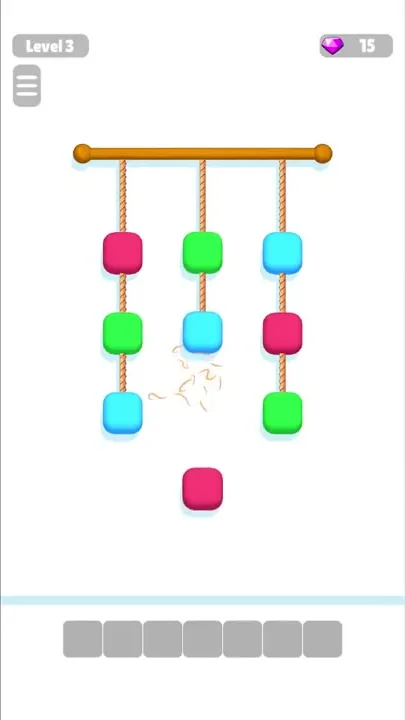
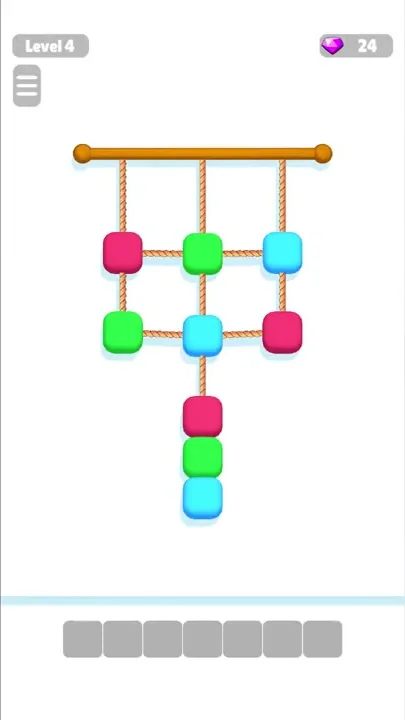
Sideways links come next. In Level 4, horizontal ropes tie the blocks into a two-row grid, with a short stack hanging from the middle of the lower row. Once the left side is cut loose, a pink and a green tumble away and the rest of the grid hangs off to the right.
From there the ropes lengthen and the blocks bunch together. In Level 5 they hang as touching groups and pairs, and orange shows up beside cyan and green.
Straight lines give way to angles next. Early in Level 6, two points on the bar each send a pair of slanted ropes to a row of four linked blocks, and zigzag diagonal ropes lead from that row to a row of three, with a cyan block under its left end and a pink under its right. Purple appears there as well, for five colors in one level.
A new piece shows up in Level 7. Early in the level, the numbered metal box hangs on its chain to the right of the ropes. On the left, a single point on the bar fans three ropes out to a touching row of blocks, and below them a purple and a green, joined by a short horizontal rope, are tied by angled ropes to a cyan block lower down.
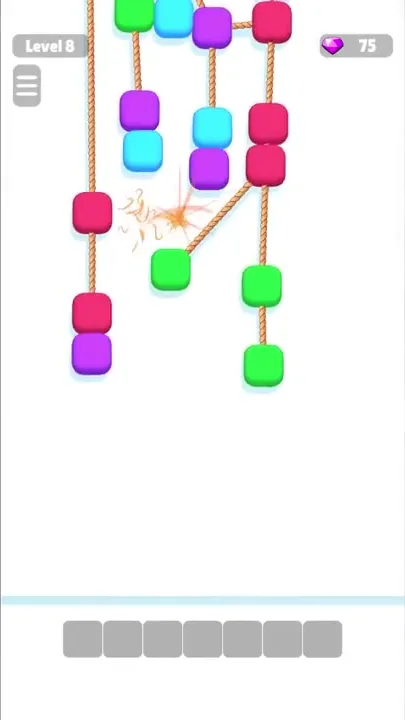
Placement changes too. Early in Level 8 the structure sits partly above the screen: the bar is out of view and the top ropes run off the edge, with blocks hanging singly and in touching pairs. Later in the level the bar is back in sight near the top, three ropes below it lead to two cyan blocks and a purple, and a tangle of slanted ropes underneath connects more linked blocks.
Level 9 goes back to three long ropes of grouped blocks. This time a short metal chain joins a pink block on the middle rope to a single pink on the right one.
A cleared level ends on a results panel. The board dims to gray behind a glowing blue frame, and the panel shows a crown flanked by two stars, a “Congrats!” banner, “Level Completed!”, a purple gem on a heap of treasure, “You are the best!” and a NEXT button. After Level 3, the panel shows up larger at one point, before its NEXT button has appeared.

A gem icon and counter sit in a gray pill at the top right. The count rises in steps during play, for instance in Level 4 just after the pink blocks clear, and keeps climbing from level to level. A gray menu button with three horizontal lines sits under the level label at the top left.
Rope cutting on a simple matching rule
We found the blend of the two styles really fun, and in play the combination adds up to more than the sum of its parts. Level 6 has both at work at the same moment: cuts on its net of diagonal ropes let blocks loose, and the tray places each arrival beside its own color and clears them in threes.
Rope cutting also carries its own strategy into the basic matching rule of tile matching. Since a cut drops whatever no other rope still holds, the cut point decides which colors reach the tray together. In Level 9, each of the three ropes mixes its colors across a single block, a pair and a group of three.
The two halves also differ in weight. The rope side is the hard, heavy one: the satisfying physics of the cuts, as a linked structure swings to a new angle and loose blocks tumble on their way down, together with the planning of where to cut. The tray side is the easy, light one: three of a color, and they’re gone. Pairing a hard half with an easy one this way is an approach that suits rebuilding a core mechanic.
The visuals work well too. Glossy rounded blocks in bright colors hang from braided tan ropes on a plain white background, under an orange rod with a round knob at each end.
Cut and Match runs a bit thin
The game is on the thin side and not built out far enough. That gap doubles as an opening, with room left for other studios to take the idea further.
Planning cuts and watching colors land
Each cut starts with reading the structure: which blocks hang below which rope, which touching groups will drop as one, and which colors will land in the tray together. Picking the rope and then watching what is left swing and fall is the main activity here, from the grid in Level 4 to the slanted ropes of Levels 6 and 8. That suits a taste for working out cause and effect before committing to a move.
The tray runs on a plain rule, sets of three in one color across a short row of slots, which anyone who already enjoys tile matching with a small tray will recognize at once. Here the blocks simply fall into it.
Verdict
Putting rope cutting together with a three-of-a-color tray gives Cut and Match a pairing that adds up to more than the sum of its two halves. It is on the thin side, though, and not built out far enough, which leaves space for anyone who wants to carry the formula further.