Tile Triple 3D Review: Tiles That Land Face Down
A Tile Triple 3D review covering thick 3D tiles that tumble out of a bucket, land face down or on edge, and clear in threes from a seven-slot tray.
Game at a glance
Tile Triple 3D
6/ 10
Our score
Sometimes physics gives the gameplay its own special 'boost.'
In this article6 sections
Tile Triple 3D is a very smooth mobile puzzle, and what makes it entertaining comes from physics rather than from a new rule. It belongs with the tile match games: the player moves tiles into a tray, and three identical tiles clear.
The difference lies in the tiles. They are thick 3D slabs poured onto a table, and some come to rest face down or on an edge with their pictures hidden. This style of play has probably been around for a long while, and that piece of physics is what earns this one attention.
Thick tiles heaped above a seven-slot tray
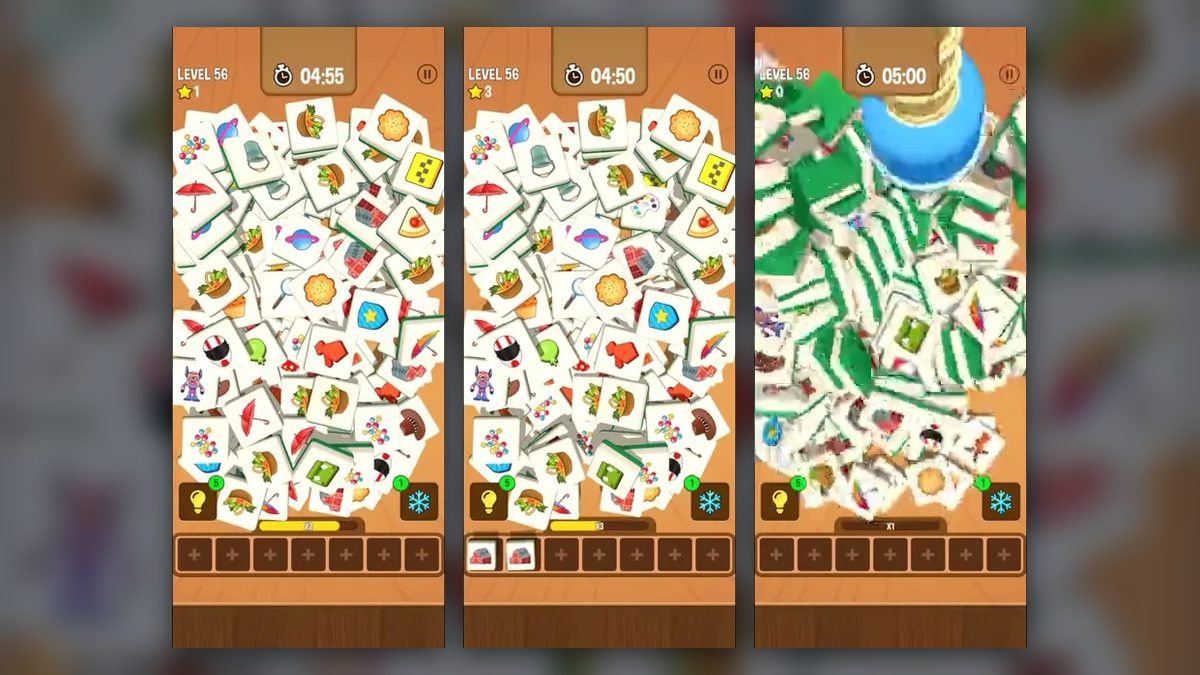
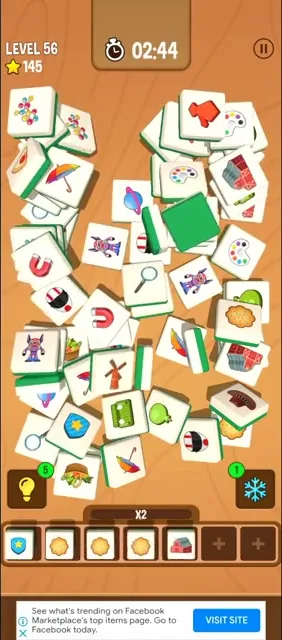
Tile Triple 3D shows no goal on screen in Level 56, the one level we played. The header holds the level number with a star counter beneath it at the top left, a countdown timer in a hanging wooden plaque at the top center and a pause button at the top right. The pile fills the middle of the screen and the tray sits at the bottom. Play follows a single rule: three identical tiles in the tray clear together.
The tiles look much like mahjong tiles: thick slabs with white faces and green backs and sides. Each face carries a cartoon icon, such as an umbrella, a pizza slice, a yellow taxi sign, a planet, a magnet or a sunflower. They overlap at random angles, so only the tiles on top show their pictures in full, while those lower down are partly covered.
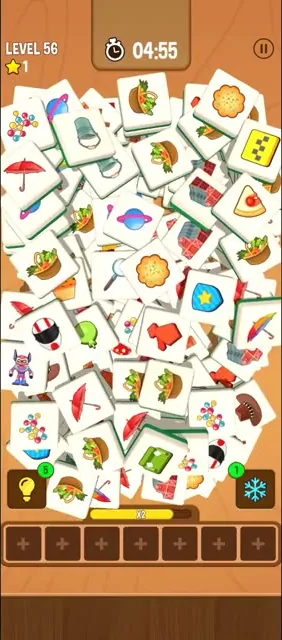
Control comes down to choosing a tile. Tiles leave the heap one at a time and reappear in the wooden tray under the board. Apart from two booster buttons above the tray, the pause button is the only other control.
Tile Triple 3D gameplay repeats one cycle: lift a tile off the pile and send it to the tray, then complete sets of three. Early in the level, two brick tiles sat side by side there with room for a third. The cycle goes on as the heap is worked down toward bare wood.
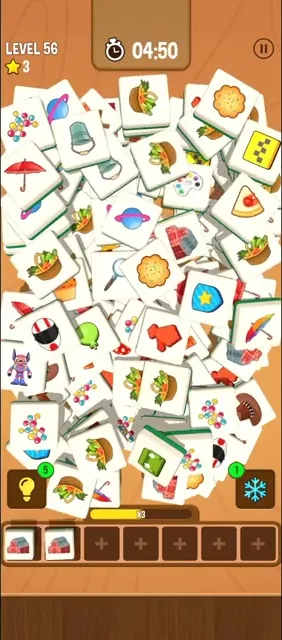
The tray is a wooden rail with seven evenly spaced slots, each marked with a plus sign while empty. At one point six of the seven slots were taken, three by candy tiles and two by umbrellas, with a shield at the left end and one slot still open. The tray filled back up to six later in the level.
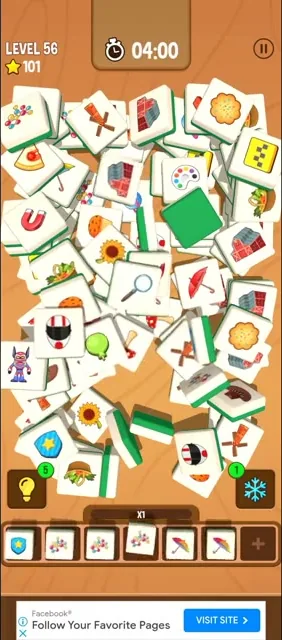
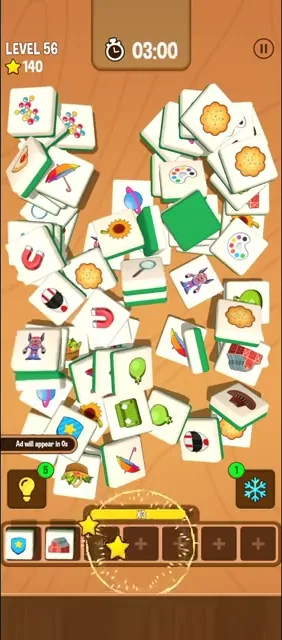
The three candy tiles were gone moments later, leaving the shield and the umbrellas behind. Clears show a large gold star inside a ring of sparkles over the tray. Smaller stars stream up the left side of the screen toward the star counter.
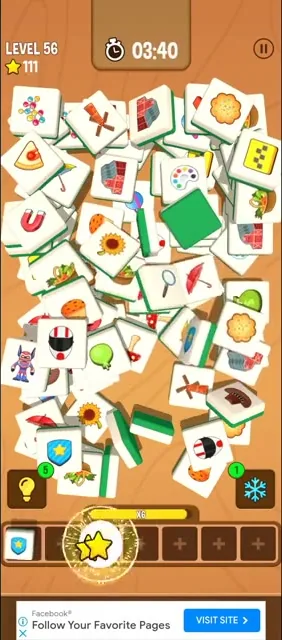
A yellow combo bar runs between the two booster buttons, just above the tray, with an X multiplier label. At several points it reads X1 with the bar empty. After clears it climbs (X2 and X3 after the candy and umbrella sets, X6 at several other points) with the bar partly filled, and it drops back to X1 at times.
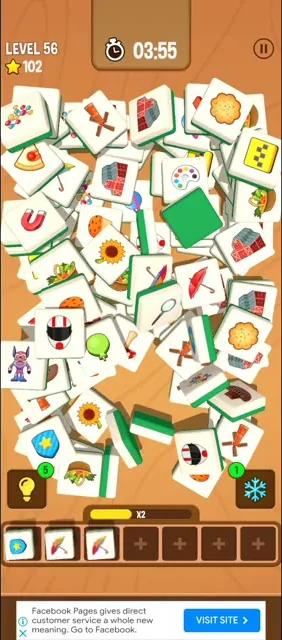
Some tiles lie face down, with only their plain green backs showing and their icons hidden. One sat near the top center of the heap for much of the level before it was gone, and others turned up at the left edge and in the middle later on.
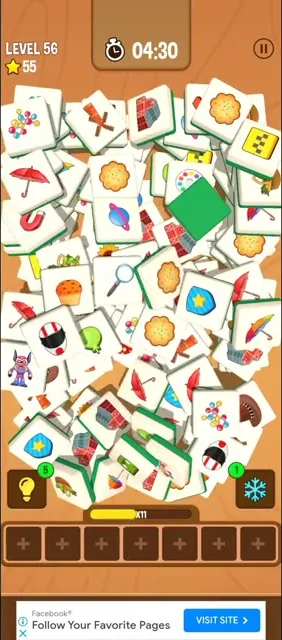
Other tiles stand upright on an edge, so all that shows is a thin green-and-white strip with no picture. Several stood this way once the pile had thinned, and one was still upright among the last tiles on the table.
From a poured heap to bare wood
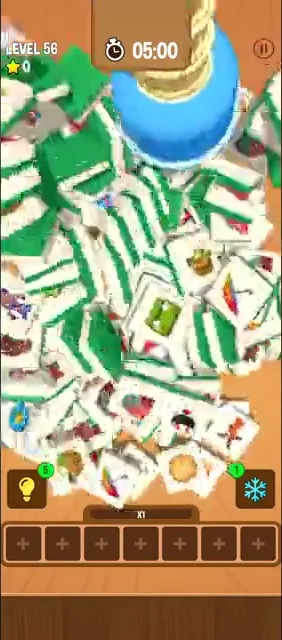
First comes a title screen with the logo on a purple ribbon and a cartoon carrot perched on top. The level then opens with a blue bucket on a rope tipping the tiles onto the table while the timer stands at 05:00. Within seconds they settle into one dense heap that stretches from just below the timer down to the booster buttons.
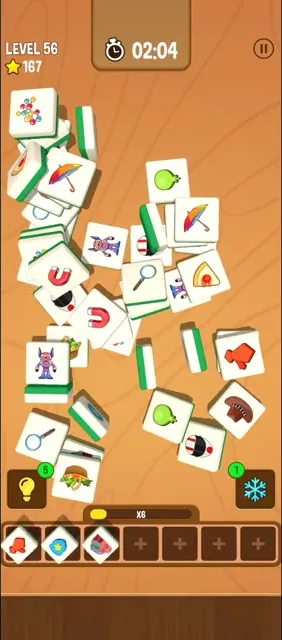
Within the level, the pile changes shape as tiles are taken. By the middle, bare table shows through gaps in the center and along the edges of the pile. More of what remains lies tilted, face down or on an edge.
Toward the end, only scattered tiles were left on the light wooden table with its contour-line grain. Two lay face up and a third stood on its edge, while the tray held three more. The timer still showed 01:09.
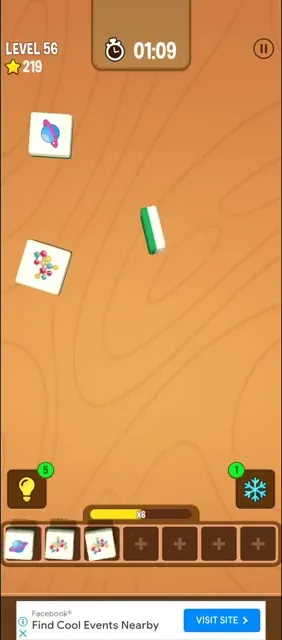
Outside the tiles themselves, the level keeps a tally of stars. The counter under the level number starts from nothing and climbs as sets clear, fed by the small stars that rise from the tray.
Two round booster buttons flank the board just above the tray: a lightbulb on the left and a snowflake on the right, each with a small green number badge. Neither one was used during the level.
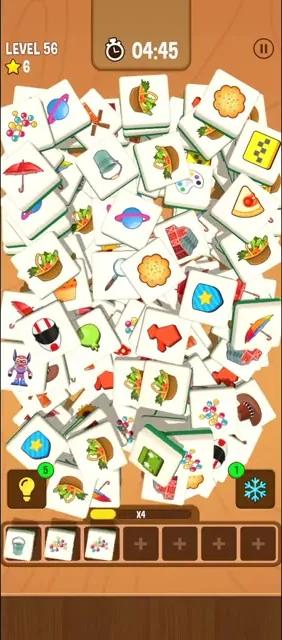
A Facebook banner ad with a blue VISIT SITE button runs along the bottom of the screen for most of the level. It switches between messages such as “Follow Your Favorite Pages” and “Find Cool Events Nearby.” The banner was missing during the opening seconds and at a couple of moments later on.
Midway through, a small black label reading “Ad will appear in 0s” popped up above the lightbulb booster, just as a gold star burst over the tray from a fresh clear.
Face-down tiles and edge-standing slabs
Hidden tiles appear here without any rule calling for them. Flat 2D triple-tile matching puzzles place face-down tiles in their layouts on purpose. Tile Triple 3D gets the same hidden-tile finish from the way its slabs fall: the tile lying green side up near the top of the heap, or the one left standing on its edge among the last few on the table. We found that quite entertaining.
That hidden-tile effect is the special boost the physics gives the play: the pictures are hidden by how the slabs fall, not by a rule. Poured from a bucket, the tiles lie at random angles in a physics-based pile, and some of them end up face down or on an edge.
It also plays very smoothly, from the opening pour down to the final scattered tiles.
An unfinished Level 56 and two idle boosters
We have no specific criticism of Tile Triple 3D. Some parts of the game simply did not come up. Level 56 was still unfinished when play stopped, so no win screen or results appeared, and we never saw what a full tray or an empty timer leads to. The lightbulb and snowflake boosters were never pressed either.
Digging a pile down against the clock
Play here means scanning a loose heap of overlapping pictures and pulling out the tiles that finish a set, with a five-minute timer running in the plaque overhead. Nothing sits on a grid, so spotting the next match means reading tiles at odd angles. Some are half buried, and some show only a green back or a thin edge.
The tray and the rule of three will be familiar to anyone who plays flat triple-tile matching puzzles. What differs is a board laid out by a pour rather than by a fixed arrangement. A star counter and a combo bar climb as sets clear.
Verdict
Smooth-running, with one quite entertaining effect of its physics, Tile Triple 3D lands at a moderate rating overall. Letting physics settle the slabs recreates the hidden pictures of flat tile puzzles without a rule written for it, and that gives the play an extra lift. Past that, it plays as a straight tile match with 3D pieces.