Elastrio Review: Rubber Bands Stacked Like Tiles
Colored rubber bands on a five-by-five peg board take the place of stacked tiles, and our Elastrio review follows them into a seven-slot tray.
Game at a glance
Elastrio
8/ 10
Our score
Rubber-band wrapping, rubber-band play, tile matching underneath.
In this article6 sections
Elastrio offers a very fresh original take on tile matching with a small tray, and the idea behind it makes sense. Rubber bands stand in for stacked tiles, and because bands stretch, a board can be laid out in many new ways. Its weak side is the presentation: the background is too bright, and the effect when bands clear is a bit hard to read.
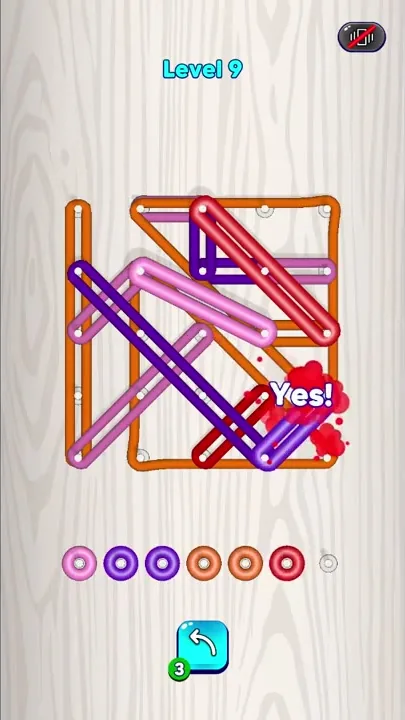
Elastrio is a mobile untangle ropes game played on a five-by-five grid of pegs. Colored bands overlap across the pegs. Each band that comes off turns into a ring in a seven-slot tray below the board, where rings of one color gather in threes. Across the eight levels we played, from Level 2 to Level 9, every board was emptied up to Level 8, and play stopped late in Level 9 with two bands still on the pegs.
Rubber bands over a five-by-five peg grid
The goal is an empty board, so every band has to come off the pegs. When the last one goes, only the bare grid is left, followed by a “You Win!” screen with a Next button. The game shows no target while a level is under way, and the wood around the board carries neither a move count nor a timer. The one visible limit is the row of seven slots under the board.
The view never moves. Each level is a fixed, top-down portrait screen with the level number in cyan at the top center and the board in the middle. The tray sits beneath the board, with an undo button under the tray. Bands leave the board singly, each with its own splash.
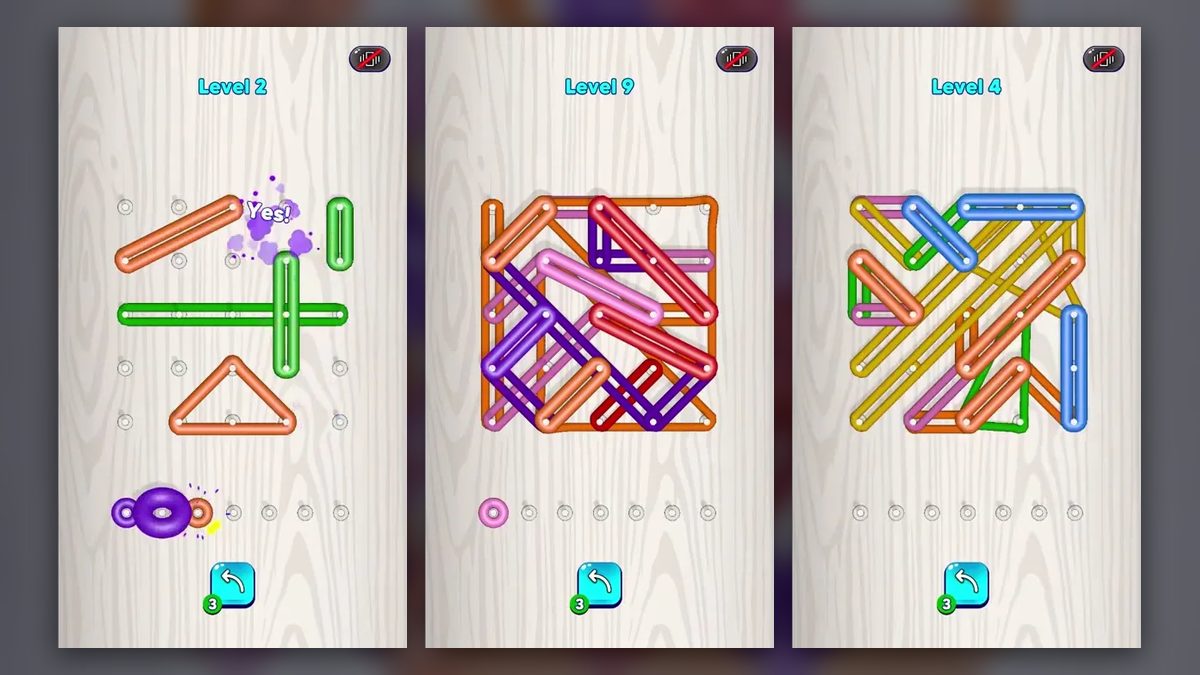
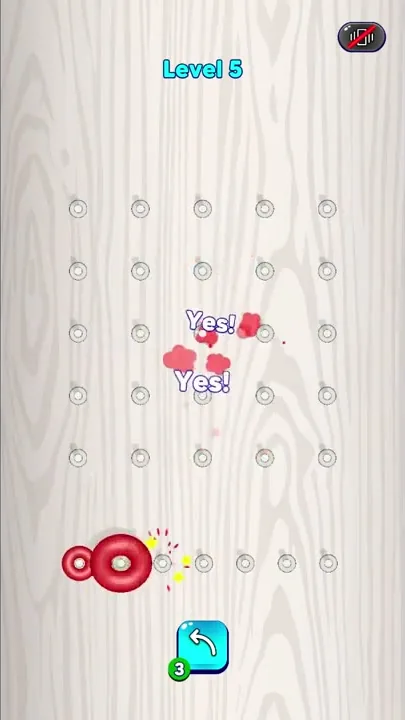
Elastrio gameplay runs on a single loop, repeated until the board is bare. When a band leaves the pegs, a white “Yes!” pops up over a paint-like splash of its color where it sat. A ring of that color appears in the tray, filling the slots from the left, and rings of one color end up side by side.
Under every tangle is the same board: a five-by-five grid of small gray pegs set into pale wood. All the bands are stretched over these pegs. The bare grid is what remains when a level ends, and it stays visible behind the win screen.
The bands look like glossy tubes looped over pegs, with a white dot wherever one touches a peg. The shortest span two neighboring pegs. Longer ones run straight past several pegs, sometimes across the whole middle row or down the full left column, and some hook over three pegs as triangles.
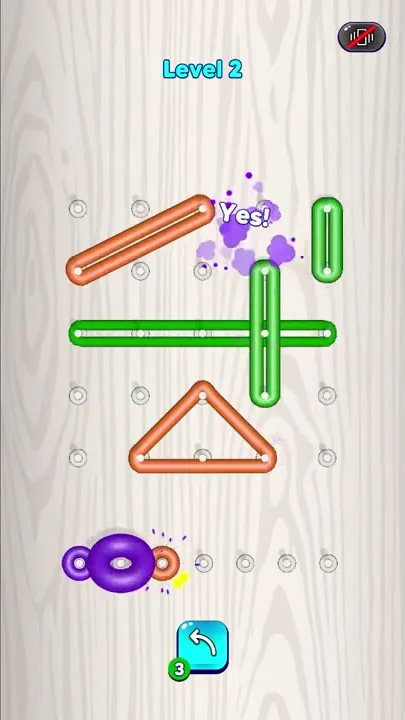
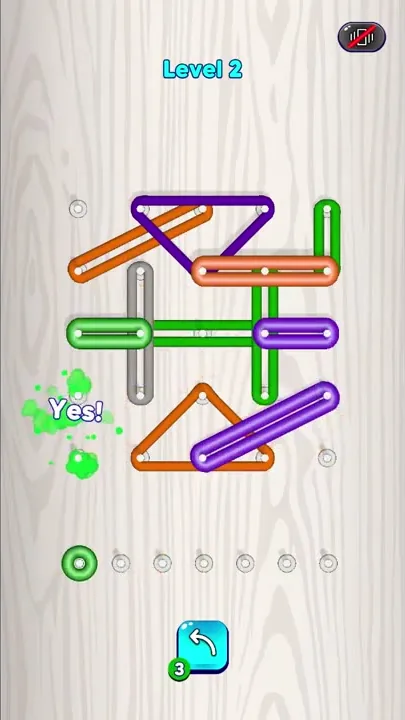
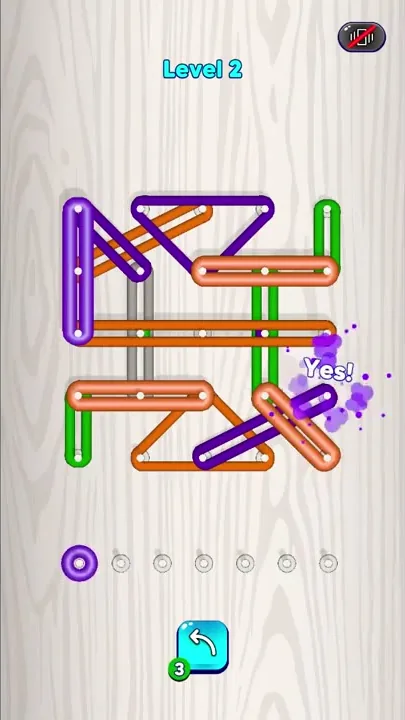
Bands lie on top of one another, and the drawing shows the order. A band with nothing over it is thick and glossy, while one lying under others is thin and darker. In Level 2, an orange diagonal at the upper left stays thin while a purple triangle lies across its end, then turns thick once the triangle is off. Early in Level 9, the whole board is a packed square of these layers.
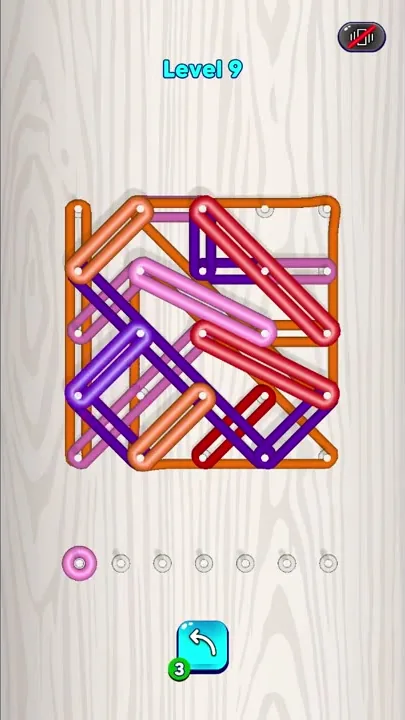
The tray is a row of seven ring-shaped slots. Each band that leaves becomes a donut-shaped ring there, with the newest one briefly drawn larger as it arrives. Rings of the same color sit side by side in every tray seen: two blue beside two orange in Level 8, or six rings in four colors with one slot open in Level 9. No losing screen came up, and the fullest tray we saw held six, one short of full.
Three rings of one color do not stay long. A trio lines up with its third ring drawn larger as it arrives, as red rings do in Level 3 and yellow ones in Level 8. Shortly afterward the trio is gone from the tray. That is the basic rule of tile matching, carried over to rubber bands.
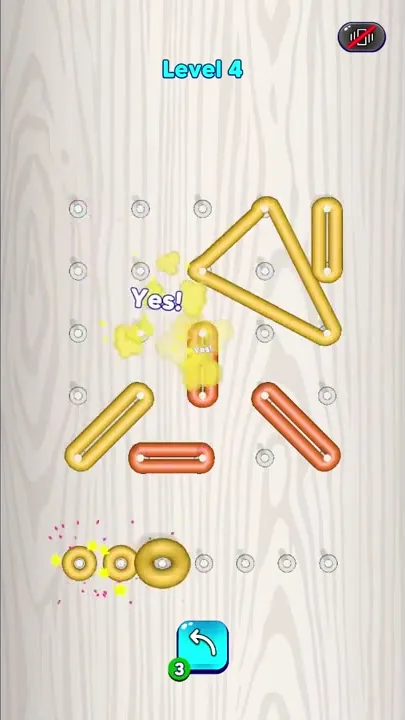
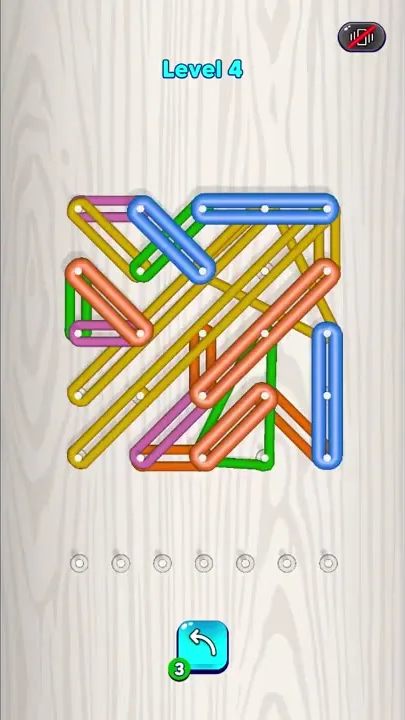
Blue bands lie on top of the Level 4 tangle as it opens, along the top row and down the right column, with the tray still empty. By the time a lone green ring sits in the tray, the blue bands are off the board, and a short orange band on the bottom row is drawn thin under a pink one. A few removals later the pink is gone and that orange band is thick and glossy. The board is down to a yellow triangle, two short yellow bands and three orange bands, while a third yellow ring settles beside two others in the tray. The “You Win!” screen comes next.
Colors pile up while layouts change shape
Short loops, long straight bands and triangles are all already on the board in Level 2. Late in Level 9, large orange triangles spanning four pegs on two sides appear. Beyond that, the changes come from how many colors share a board and how the bands are laid out.
The first two boards use four colors each, with overlapping bands covering most of the grid. Purple and orange share the Level 2 board with green and gray. Pink bands first appear in Level 3, where green is the only color carried over.
Five colors share a board for the first time in Level 4, which is also where blue first shows up. Its opening tangle is a dense square. Several long yellow bands run diagonally from the lower left toward the upper right, with orange diagonals lying across them.
More colors share the Level 6 board than any other board here, in a square tangle built around red vertical and diagonal bands. Long purple bands cross its top with yellow and gray diagonals underneath. A red X sits at the lower right. After that the number of colors drops back to five, then four. Early in Level 7, red and blue bands run along the top and left edges while green bands stand upright at the right, with a long gray band running diagonally from the upper left toward the lower right.
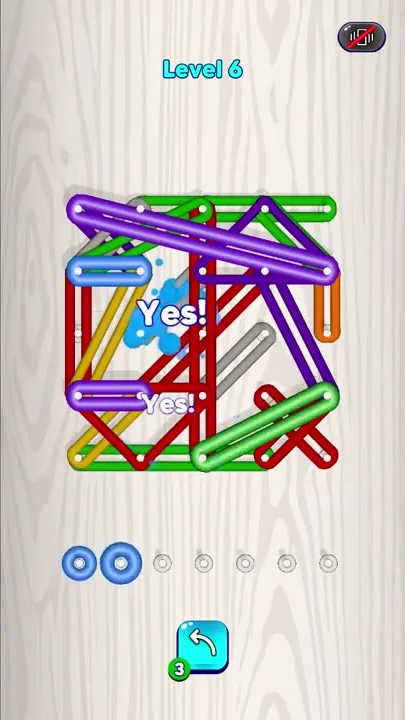
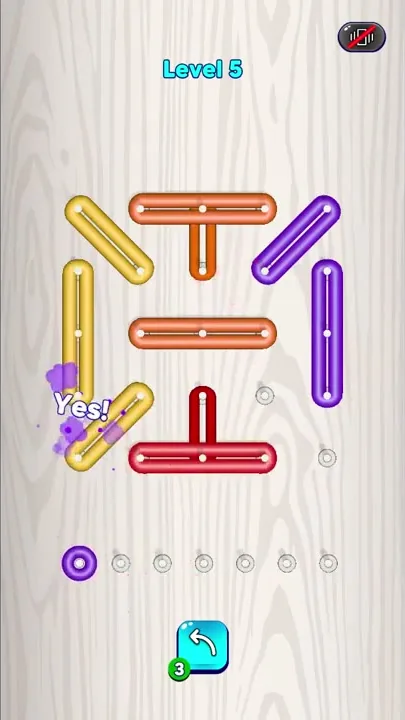
The way the bands are laid out shifts as much as the colors do. The first three boards pile their bands into tangles over most of the grid. A frame breaks that pattern in Level 5: yellow bands mostly line the left side and purple ones the right, with bars crossing the middle.
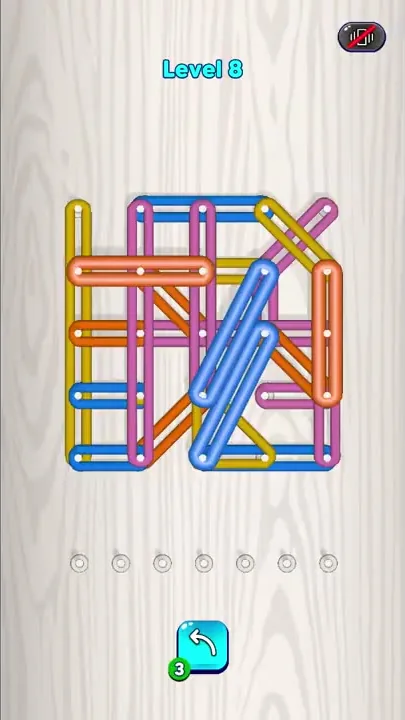
The bands form a lattice in Level 8. Yellow ones stand upright in the left column and pink ones in the columns next to it, while blue and orange bands run across the rows. Diagonals cut through all of them, with two blue diagonals on top in the center.
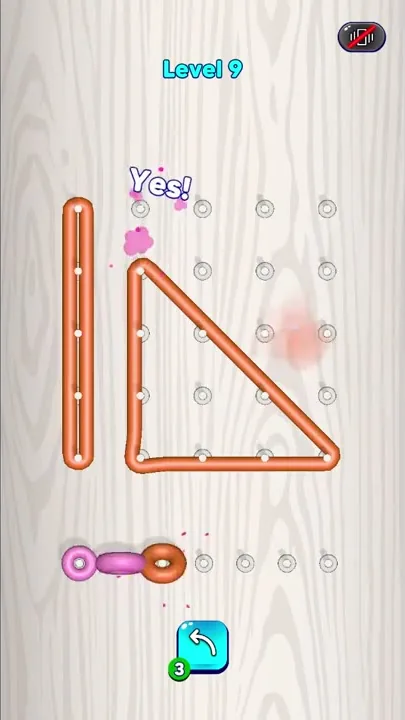
Orange bands line all four edges of the grid in Level 9, and diagonals in four colors fill the inside. Late in the level only two orange bands remain, both large. One runs the full left column, and the other is a triangle stretching four pegs along each of two sides.
Away from the bands, the screen holds little else. A cyan square undo button with a curved, left-pointing arrow sits under the tray, wearing a green badge that reads 3. The badge reads 3 in every level we saw, so the undo is never seen in use. A dark rounded button at the top right shows an icon struck through by a red diagonal slash; it stays on screen in every level and is never seen pressed.
Clearing a board dims it behind cyan “You Win!” lettering, with confetti shaped like little bands and a cyan Next button beneath. The screen hands out no stars or coins. The end of Level 8 shows an earlier moment of the win: “You Win!” over an undimmed board while colored bits burst up from both lower corners in puffs of white smoke, before any Next button appears.
The screens carry no coin counter and no shop. No lives or energy showed up on them either, nor any offers or ads, and each new level came up within seconds of the last one ending. That puts Elastrio far from Coin Master, the slot-machine village builder, and other games like coin master, at least through Level 9.
Stacked bands in place of stacked tiles
Elastrio is another very fresh reworking of tile matching, and an advanced one. Its central swap shows why. On a tile-matching board, tiles stack and cover one another. Here rubber bands lie across each other instead, and covered bands are drawn thin and dark, as the long yellow diagonals are under the blue and orange bands at the start of Level 4.
That swap keeps the familiar rules in place. Bands leave the board for a tray of seven, and rings of a color gather in threes and go, as tiles do in tile matching. The rubber-band dressing turns that loop into new play that is both sensible and interesting.
The stretch of a rubber band is put to use as well. One band can span a whole row or hook over three pegs, so boards take many new forms, from the frame of Level 5 to the lattice of Level 8.
Underneath it all, picking pieces into a small tray and clearing them in threes is a very good mechanic. In our view, tile matching is, for now, the puzzle line with the best chance of catching up with match-3. The studio behind Elastrio is a hidden gem too, and anyone interested can follow its work.
The pale wood backdrop and band effects
The background is too bright. Near-white wood grain fills the screen from top to bottom, with the gray pegs set into it as small rings.
To our eyes, the look of the screen and the craft of the bands could take more tuning, both in how the bands are textured and in how they move. The bands themselves are glossy tubes with white dots at each peg, like the long green band across the middle row of Level 2.
When bands clear, the effect is slightly hard to follow. On screen, the clearing effect works like this. Each removal sets off a white “Yes!” over a paint splash, sometimes two at once, while the newest ring swells in the tray and overlaps its neighbors, as the big purple ring does in Level 2. Late in Level 9, one ring is drawn stretched into an oblong pink shape between a pink ring and an orange one.
Picking apart layers of colored loops
The play here is reading a pile. Which bands lie on top shows in how thick and bright they are; bands come off one at a time, and each ring joins others of its color in the tray. Anyone who likes picking pieces off a covered pile in tile matching gets the same act with rubber bands, on boards whose shapes change from level to level.
The peg board and its crisscrossing bands look like an untangle puzzle. What differs is the tray underneath, where every band turns into a ring and colors gather in threes.
Verdict
Swapping tiles for rubber bands gives tile matching a very fresh, well-reasoned new form. Stretching bands open up new shapes for a board while the rules underneath still hold. The weaker side is how it looks on screen: the backdrop is too bright, the bands’ texture and motion could take more tuning, and the effect when they clear is a little hard to follow.